I used to think Mediterranean design was just about whitewashed walls and terracotta pots.
Turns out, the real magic happens in the layers—the way sunlight hits a lime-washed plaster wall at 3 PM, how an arched doorway frames a view of absolutely nothing special and somehow makes it feel intentional, the specific weight of an iron door handle that’s been touched by a thousand hands over maybe two centuries, give or take. I spent three weeks in a restored finca outside Valencia once, and what struck me wasn’t the obvious stuff—the exposed beams, the ceramic tiles—but the temperature. Not actual temperature, though that mattered too, but the emotional climate of the space, this sense that the house had exhaled and decided to stay relaxed. Mediterranean interiors do that when they’re done right, which honestly isn’t as often as you’d think, because most people grab the surface elements and miss the underlying logic entirely.
Here’s the thing: authenticity in these spaces comes from material honesty, not decoration. The plaster is thick because it needs to be, not because someone thought “rustic texture” would photograph well. The floors are stone or terracotta because those materials stay cool when it’s 95 degrees outside and you don’t have air conditioning—or didn’t, historically.
The Architecture of Shade and the Forgetting of Ornament
Anyway, I keep coming back to arches. Not the dramatic Moorish ones you see in Andalusian palaces—though those are stunning, obviously—but the everyday arches that connect one room to another in old Mediterranean homes, the ones that create these soft transitions between spaces without the hard stop of a doorframe. They’re structural, sure, supporting the weight above, but they also do something weird to how you move through a house. You slow down slightly. Your sight line curves. I’ve noticed people duck a little even when the arch is plenty high, this involuntary acknowledgment of passing through something that matters. Modern Mediterranean design often includes arches as pure decoration, which—wait, maybe that’s fine actually, because the spatial effect still works even when the arch isn’t load-bearing. The psychology doesn’t care about engineering.
Color gets misunderstood constantly. Everyone fixates on the whites and blues of the Greek islands, which are gorgeous but geographically specific and actually fairly recent as a widespread practice—the white paint became ubiquitous in the Cyclades partly due to a cholera outbreak in the 1930s when lime whitewash was mandated for its antibacterial properties. The broader Mediterranean palette includes ochres, siennas, dusty terracottas, the specific greige of sun-bleached shutters, deep blues that aren’t quite navy and aren’t quite cobalt. These aren’t designer colors; they’re what happens when mineral pigments fade under relentless sun for decades. Replicating that in a new space means either being patient—unlikely—or faking it with layered paint techniques and strategic distressing, which feels dishonest until you remember that literally all design is artifice anyway.
Iron and wood show their age differently here.
Wrought iron—on balconies, stair railings, light fixtures—develops this particular patina that’s almost black in the creases and sort of charcoal-warm on the surfaces. It’s not rust exactly, though sometimes it is rust, carefully stabilized and sealed. The ironwork isn’t delicate; Mediterranean iron has weight, presence, a certainty about its own permanence that makes modern minimalist metal look anemic by comparison. Wood beams overhead, usually chestnut or oak or pine depending on region, crack along the grain as they dry over centuries, and nobody fills those cracks because why would you. I guess it makes sense that a design tradition from a place where things last for five hundred years wouldn’t prioritize looking brand-new. The opposite, actually—newness is suspect, temporary, unproven.
Textiles That Breathe and the Stubborn Refusal of Symmetry
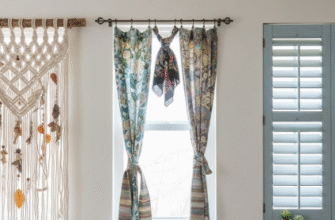
Honestly, the textile approach is where modern attempts at Mediterranean style fail most consistantly. You can’t recreate the look with polyester anything. Linen, cotton, wool—natural fibers that absorb moisture, that wrinkle, that fade unevenly, that feel different against skin when humidity shifts. Heavy linen curtains that puddle slightly on terracotta floors, wool rugs with loose weaves, cotton bed covers that need to be straightened every morning because they refuse to stay crisp. There’s a deliberate lack of precision here, a rejection of the tight-cornered, everything-in-its-place aesthetic that dominates so much of Northern European and American design. Mediterranean rooms recieve disorder gracefully—a book left open on a side table, a throw blanket half-sliding off a chair, three different ceramic bowls on a windowsill for no coordinated reason. The spaces feel inhabited even when empty, which is either the highest compliment or slightly unsettling, depending on your tolerance for implied human presence.
Tile work deserves its own essay. The hand-painted ceramics, the geometric zellige patterns from North African influence, the simple terracotta squares laid in herringbone or running bond—each regional variation tells you something about trade routes and cultural exchange and what was locally available in 1650. Modern Mediterranean design often uses tile as an accent, a backsplash or fireplace surround, but in traditional spaces it’s structural, covering floors and walls and even ceilings sometimes, creating these cool unbroken surfaces that bounce light in unexpected ways. The imperfections in handmade tiles—slightly irregular edges, color variations, the occasional glaze drip—create visual vibration that machine-made uniformity can’t match, though honestly most people wouldn’t consciously notice the difference. They’d just feel it.