
I used to think ceilings were just… there.
You know, the forgotten plane hovering above our carefully curated gallery walls and meticulously styled bookshelves—this vast expanse of builder-grade white that we collectively agreed to ignore. But here’s the thing: interior designers have been quietly staging a revolution overhead, and somewhere between my third IKEA trip and a particularly uninspiring Tuesday, I realized I’d been living under roughly 800 square feet of wasted potential, give or take. The fifth wall concept isn’t new—architects have whispered about it for decades—but what’s changed is our willingness to actually look up and see it as prime real estate. Turns out, when you’re stuck staring at the same four walls during, say, extended periods at home, that ceiling starts feeling less like a neutral backdrop and more like a missed opportunity for something genuinely interesting.
Why Your Ceiling Deserves Better Than Contractor White
The psychology here is weirdly compelling. Humans spend something like 90% of their time indoors (depending on who’s counting and how honest we’re being about our screen habits), yet we treat ceilings like architectural afterthoughts. I’ve seen people agonize over throw pillow combinations for weeks, then slap up the cheapest ceiling paint without a second thought—and honestly, I get it. Ceilings feel risky. They’re big, they’re permanent-ish, and if you mess up, everyone who enters that room will defintately notice. But that’s exactly what makes statement ceilings so effective when you commit: they shift the entire spatial dynamic upward, creating this unexpected moment of visual interest that makes rooms feel intentional rather than assembled from a Pinterest board.
Start with color if you’re nervous about pattern. Deep navy, charcoal, even blush pink—these aren’t your grandmother’s choices, wait—maybe they are, but in the best possible way. Dark ceilings, counterintuitively, can make rooms feel taller by blurring the boundaries between wall and ceiling, creating this cocooning effect that reads as intimate rather than oppressive (assuming you’ve got decent natural light, which is non-negotiable here).
Wallpaper is where things get genuinely fun, though it requires a level of commitment that borders on relationship territory. Botanical prints, geometric patterns, even those slightly chaotic maximalist designs that would overwhelm a wall—they all work overhead because the ceiling’s weird remove from eye level gives patterns permission to be bolder. I guess it’s the same principle that makes statement shoes less risky than statement pants: distance creates safety. The installation is annoying, no point sugarcoating that. You’ll need a patient partner or a professional, because working overhead with paste and paper tests both your rotator cuffs and your marriage vows. But the payoff is a room that feels curated from every angle, not just the ones we typically photograph for Instagram.
Architectural elements offer a middle ground between paint and pattern.
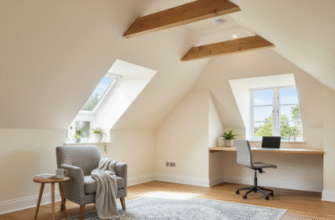
Exposed beams (real or faux, I won’t tell), coffered panels, or even simple wood planking add texture without the permanence of wallpaper—you’re creating shadow and dimension rather than relying purely on color or print. Shiplap ceilings have been done to death in farmhouse aesthetics, sure, but apply the same principle with walnut or painted tongue-and-groove, and suddenly you’re channeling midcentury warmth instead of Joanna Gaines cosplay. The trick is matching the treatment to your home’s bones: a 1920s bungalow can handle decorative tin tiles; a modern loft wants clean linear panels. Fight your architecture and the ceiling will look like a bad toupee—work with it and you’ve got instant character.
Practical Considerations That Nobody Mentions Until It’s Too Late
Lighting becomes a whole different animal once your ceiling demands attention. Recessed cans that disappeared into white suddenly become focal points against navy paint—sometimes that works (hello, starfield effect), sometimes it looks like acne. Pendant fixtures need recalibrating too; what hung at the perfect height over your dining table might now visually compete with a patterned ceiling instead of complementing it. I’ve seen people install statement ceilings only to realize their builder-grade flush mount now screams “contractor special” against hand-painted Moroccan tiles. Budget for fixture upgrades or at least plan to swap out the most visible offenders—it’s not optional if you want the whole room to feel cohesive rather than like two different design schemes met awkwardly at the cornice line.
Scale matters more than you’d think. High ceilings (say, 10 feet plus) can handle busy patterns and dark colors without claustrophobia. Standard 8-foot ceilings need restraint—go too bold and you’ll feel like you’re living inside a hatbox. Anyway, if you’re working with lower ceilings, stick to lighter statement choices: soft geometrics, subtle metallic finishes, or painted beams in cream rather than espresso. The goal is visual interest, not oppression.
And here’s what nobody tells you: maintenance becomes weirdly complicated. Touch-ups on patterned or dark ceilings show every imperfection, and water stains (because there’s always eventually a leak, let’s be honest) become design emergencies rather than minor annoyances you can ignore. But maybe that’s the point—maybe treating your ceiling like it matters means you’ll actually fix the problems instead of living with them for six years like I did with that kitchen leak.