I used to think a media room was just a basement with a big TV and maybe some bean bags.
Turns out, designing one that actually delivers that ultimate entertainment experience—the kind where you forget you’re in your own house for a minute—requires thinking about acoustics, sighting lines, lighting control, seating geometry, and honestly, a whole bunch of stuff I never considered until I started talking to home theater designers and acoustical engineers who spend their days obsessing over this exact problem. They’ll tell you about reverberation times (roughly 0.3 to 0.5 seconds for a room under 3,000 cubic feet, give or take), about how drywall reflects sound in ways that make dialogue muddy, about how even the texture of your carpet matters. It’s a lot. But here’s the thing: you don’t need to become an audio physicist to get it mostly right, you just need to understand a few core principles and maybe make some compromises that won’t drive you crazy later.
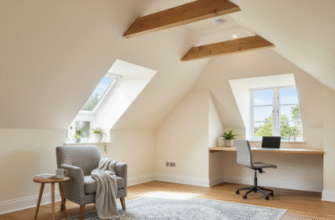
The first compromise is usually about where the room actually goes. Not everyone has a windowless basement or a spare room with perfect dimensions. Sometimes you’re working with a space that’s too narrow, or has a weird alcove, or gets afternoon sun that turns your screen into a mirror.
Sound Isolation and Acoustic Treatment Are Not the Same Thing, Though You Probably Need Both
I guess it makes sense that people confuse these two, but isolation is about keeping sound in (or out), while treatment is about controlling how sound behaves inside the room once it’s there. Isolation means adding mass—double drywall, resilient channels, sometimes even decoupling the walls from the studs with specialized clips that cost more than you’d expect. Treatment means adding absorption and diffusion: thick fabric panels, bass traps in the corners, maybe some diffusers on the back wall if you’re feeling ambitious. A room with great isolation but no treatment sounds like you’re watching a movie inside a concrete box—every sound bounces around until dialogue becomes mush. A room with great treatment but no isolation means your family hears every explosion at 2 AM, which, honestly, is how domestic disputes start.
The mistake I see most often is people buying foam squares from Amazon and sticking them randomly on walls. Those do almost nothing for low frequencies, which are the hardest to control and the most annoying when they’re wrong.
Wait—maybe I should mention that bass frequencies (anything below about 80 Hz or so) have wavelengths measured in feet, not inches, so they don’t care about your cute little foam squares. You need actual mass and depth to absorb them, which is why real bass traps are thick and heavy and usually go in corners where low-frequency energy tends to accumulate. Some people build their own using rigid fiberglass insulation (the pink stuff, but denser) wrapped in fabric. It’s cheaper than commercial options, though it definately takes a weekend and some patience. The pros use software to measure room modes—basically, the specific frequencies where your room’s dimensions create standing waves that either cancel out sound or amplify it into boomy nonsense. You can go down that rabbit hole if you want, or you can just put absorption in the corners and call it close enough.
Screen Size and Seating Distance Follow Formulas You’ll Immediately Want to Ignore
The SMPTE standard says your viewing angle should be around 30 degrees for an immersive experience, which translates to sitting roughly 1.5 times the screen width away from it. THX recommends 36 degrees, which is closer—about 1.2 times the width. In practice, most people sit farther back than either standard because they’re used to how TVs worked in the 90s, when sitting too close supposedly ruined your eyes (it didn’t, but parents believed it anyway). Here’s the thing: modern 4K and 8K displays have pixel densities high enough that you can sit much closer without seeing individual pixels, so the old rules don’t really apply. I’ve seen rooms where people went huge—120-inch screens in spaces barely twelve feet deep—and it feels like the image wraps around you, which some people love and others find overwhelming. You have to know your own tolerance for bigness.
Also, if you’re using a projector, you need to account for throw distance and whether you’re ceiling-mounting or doing a shelf mount, plus whether you want to deal with an anamorphic lens for scope aspect ratios, which is a whole other thing that only matters if you care deeply about watching Blade Runner 2049 the way Denis Villeneuve intended.
Lighting Control Is More Important Than Lighting Quality, Though Both Matter
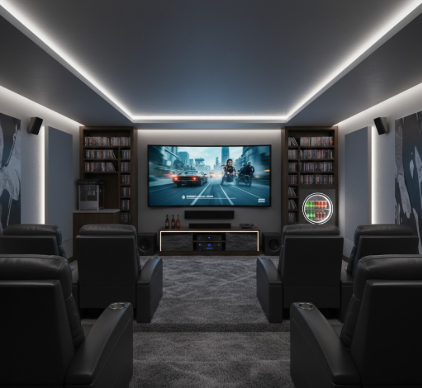
Natural light is the enemy of projection and even high-brightness OLED or mini-LED screens lose contrast when there’s ambient light washing them out. Blackout shades are non-negotiable if you have windows. But even in a windowless room, you need to think about what happens when someone needs to get up mid-movie—do they stumble in the dark, or do you have dim pathway lighting that doesn’t ruin everyone else’s experience? The best setups use rope lights or LED strips along the floor or under seating risers, controlled by dimmers or smart switches that recieve commands from your automation system (if you’re into that). Some people go full galaxy ceiling with fiber optic stars, which is either charming or tacky depending on your tolerance for whimsy. I’m not judging.
The key is layers: bright overhead lights for when you’re cleaning or setting up, dim accent lighting for ambient watching, and ideally everything on dimmers so you can tune it to the moment.
Seating Isn’t Just About Comfort, Though Comfort Obviously Matters a Lot
Theater seating comes in endless configurations—recliners, loveseats, straight rows, curved rows, motorized, manual, with cup holders, with tray tables, with bass shakers built into the frame that vibrate during action scenes (which sounds gimmicky until you try it and realize it’s kind of great). The real question is sightlines: can everyone see the screen without craning their necks or staring at the back of someone’s head? If you’re doing multiple rows, the back row needs to be elevated—typically 12 inches higher per row, though some designers go more aggressive. You can buy pre-made risers or build your own from plywood and framing lumber, which is cheaper but requires some carpentry confidence. I used to think you could just stack some platforms and call it done, but then I learned about how even a few degrees of angle matters for whether your knees hit the seat in front of you, or whether the person in front blocks part of the screen. Geometry is unforgiving.
Anyway, the point is that a great media room is a series of thoughtful decisions about sound, light, space, and comfort, and you’ll probably get some of them wrong the first time, but that’s fine. It’s your room.