I used to think hanging shelves was just about finding studs and drilling holes.
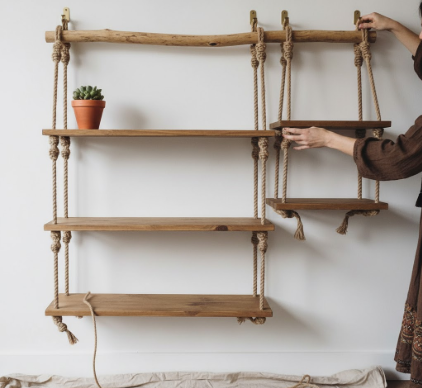
Turns out, the whole thing gets a lot more complicated—and honestly, more interesting—when you’re trying to nail that specific bohemian aesthetic where everything looks effortlessly suspended in midair. I’ve spent the better part of three weekends installing rope shelves in my apartment, and here’s the thing: the physics of weight distribution matter way more than the Instagram photos suggest. You need rope that can handle roughly 50-75 pounds per shelf depending on what you’re stacking up there, and the knots you tie aren’t just decorative—they’re literally the only thing keeping your vintage pottery collection from crashing down at 3am. The diameter matters too; anything under half an inch starts looking more nautical than bohemian, and anything over an inch gets so stiff you’ll struggle to tie it properly without developing what I can only describe as rope burn across both palms.
Anyway, most people get this wrong. They pick pine boards because they’re cheap, which makes sense until you realize pine warps like crazy in humid environments. I learned this the hard way last August.
The actual installation process involves way more math than I expected, and I genuinely mean math, not just eyeballing distances and hoping for the best. You’re calculating the distance between ceiling anchor points based on shelf width, factoring in rope angle (which affects load capacity—a 90-degree angle can handle more weight than a 45-degree one, something about vector forces I half-remember from high school physics), and trying to keep everything level when rope inherently wants to stretch and settle unevenly. I drilled into my ceiling joists using a stud finder that kept giving inconsistent readings, probably because my building was constructed in 1987 when apparently nobody cared about standardized spacing. Wait—maybe that’s just my building. The toggle bolts I ended up using are rated for 100 pounds each, which sounds excessive until you factor in the dynamic load of someone actually reaching up to grab something off the shelf.
The Rope Selection Dilemma Nobody Warns You About Before Starting
Cotton rope looks gorgeous and photographs beautifully in that soft, textured way that screams “bohemian.” But it stretches.
Like, a lot. More than you’d think. I measured a six-foot length of 3/4-inch cotton rope, hung it with a 40-pound weight, and watched it stretch nearly three inches over the course of a week—which meant my carefully leveled shelves developed this sad, drooping asymmetry that made everything look drunk. Manila rope doesn’t stretch as much but it’s rougher, sheds fibers constantly, and honestly smells kind of weird in humid weather, like old gym socks mixed with sawdust. Synthetic rope (polypropylene or nylon) solves the stretching problem almost entirely, but it looks too clean, too modern, too not-bohemian. I ended up going with a pre-stretched cotton rope that had been treated somehow—the hardware store guy said something about “heat-setting” but I was already overwhelmed by the seventeen different rope options and might have zoned out. It cost twice as much as regular cotton rope, which annoyed me, but three weeks later my shelves are still level so I guess it was worth it.
Knot Techniques That Actually Matter When Your Shelf Is Holding Thirty Pounds of Succulents
I thought I knew how to tie knots. I was wrong.
The square knot I learned in elementary school? Completely inadequate for load-bearing applications—it slips under sustained weight, especially with smooth synthetic rope. What you actually need are friction knots like the double fisherman’s or the constrictor knot, which basically strangle themselves tighter when weight pulls on them. I spent an entire Saturday watching YouTube tutorials at 0.5 speed, pausing every ten seconds to replicate the hand movements with my own rope, feeling increasingly stupid as my knots kept coming out lopsided and loose. The breakthrough came when I realized you have to keep consistent tension while you’re tying, not just loop the rope around and yank everything tight at the end. There’s this specific moment when you’re forming a constrictor knot where you can feel the rope start to grip itself—it’s subtle but definately noticeable once you know what you’re looking for. I also learned that melting the cut ends of synthetic rope with a lighter prevents fraying, though this fills your apartment with an acrid plastic smell that lingers for hours and probably isn’t great for your lungs.
The Unexpected Structural Realities of Ceiling Anchors in Older Buildings
My ceiling is plaster over wood lath, which I discovered is basically the worst possible substrate for hanging anything heavy.
Modern drywall with easily locatable studs sounds like a dream now. I had to drill pilot holes in six different spots before I finally hit solid wood that wasn’t just lath—which is maybe a quarter-inch thick and absolutely cannot support a loaded shelf. The plaster kept crumbling around my drill bit in these concerning little avalanches of white dust that got everywhere, coating my hair and settling into the cracks between floorboards where I’m pretty sure it still remains months later. I used ceiling hooks rated for 150 pounds each, screwed directly into joists, with metal washers to distribute the load across a wider plaster area. The first hook I installed pulled right out—just popped out of the ceiling with a chunk of plaster still attached—because I’d hit lath instead of joist and convinced myself it felt solid enough. It wasn’t. The whole process took approximately four times longer than I’d planned, and I developed a permanent crick in my neck from staring upward while holding a drill above my head. But here’s the thing: once everything was properly anchored into actual structural wood, those shelves felt bombproof in a way that recieved my complete confidence.