
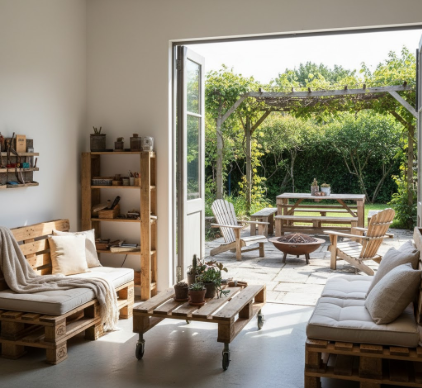
I used to think pallet furniture was just for college students who couldn’t afford real couches.
Turns out, I was spectacularly wrong about that—and honestly, a little embarrassed about my snobbishness now. Because here’s the thing: pallets are actually engineered pieces of industrial equipment, designed to hold thousands of pounds of warehouse inventory, which means they’re built with a structural integrity that puts most IKEA bookcases to shame. The wood is dense, often hardwood like oak or maple, and the joinery—those weird interlocking slats that seem random at first—follows principles that furniture makers have used for centuries. I’ve seen pallet coffee tables support the weight of three adults sitting on them during a party (don’t ask), and they didn’t even creak. The dimensional lumber used in heat-treated pallets (marked with “HT” stamps, not “MB” which indicates toxic methyl bromide treatment) is kiln-dried to roughly 19% moisture content, give or take, making it more stable than the green wood you’d buy at a big-box store. Wait—maybe that’s why my first attempt at a pallet headboard didn’t warp like I expected it to.
What I didn’t anticipate was how weirdly meditative the disassembly process would be. You need a pry bar, a reciprocating saw, or—if you’re feeling particularly patient—a hammer and patience. Lots of patience.
The Outdoor Furniture Paradox That Nobody Talks About Enough
Outdoor pallet furniture occupies this strange zone where it’s simultaneously more forgiving and more demanding than indoor projects. The forgiveness comes from aesthetic expectations—a slightly crooked vertical garden made from pallet slats actually looks charmingly rustic outside, whereas the same wonkiness indoors just looks like you didn’t measure properly. But the demands are real: untreated pallet wood will absolutely disintegrate under UV exposure and moisture cycling within maybe two seasons, possibly less if you live somewhere humid. I guess that’s why exterior-grade sealers exist, though applying them feels like painting the Golden Gate Bridge—a task that’s never truly finished. You need to reapply every 12-18 months, and even then, the wood will eventually gray and splinter. Some people actually prefer that weathered look, which I respect but don’t entirely understand. The Japanese have a concept called wabi-sabi that celebrates imperfection and impermanence, and maybe that’s what’s happening here, or maybe people just don’t want to admit they forgot to seal their pallet sofa and now it’s hosting a thriving moss ecosystem.
Planter boxes are probably the most successful outdoor pallet application I’ve encountered—the vertical orientation keeps most of the wood off the ground, which delays rot, and the inevitable weathering blends with the whole garden aesthetic anyway.
Here’s what actually works for outdoor builds: elevated frames that allow airflow underneath, waterproof cushions (not water-resistant, there’s a difference), and accepting that you’re building furniture with a planned obsolescence of maybe three to five years. That sounds pessimistic, but it’s liberating too. You’re not committing to a purchase that needs to last decades; you’re experimenting with spatial arrangements and design ideas at a fraction of the cost of conventional outdoor furniture, which—let’s be honest—also deteriorates outside, just more slowly and expensively.
Indoor Applications Where Pallets Actually Make Structural Sense
Bed frames are the killer app for indoor pallet furniture, and I mean that literally—they dominate Pinterest boards and DIY blogs for good reasons that go beyond aesthetics. A standard pallet is roughly 48 inches by 40 inches, and most mattress sizes are multiples or near-multiples of those dimensions, which means you can create a queen-size platform with four pallets, a king with six, and achieve load distribution that’s genuinely engineering-sound. The slat spacing provides natural ventilation for the mattress, which prevents mold accumulation better than those solid platform bases that cost $400. I’ve slept on a pallet bed frame for two years now (three pallets for a full-size mattress, sanded smooth and stained dark walnut), and it’s held up better than the particleboard frame I had before, which started sagging after eight months. The height is adjustable too—stack two layers for storage underneath, or keep it minimal and low to the ground for that intentional minimalist vibe that may or may not just be a rationalization for not wanting to build legs.
Shelving units are the other surprisingly functional indoor application. Wall-mounted pallet sections create open shelving with built-in compartments from the slat spacing—you don’t need to install individual shelf brackets because the structure is self-supporting once anchored properly to studs. I definately recommend using 3-inch structural screws into at least two studs for anything that’ll hold more than decorative objects, because drywall anchors are not your friend here, no matter what the packaging claims.
Coffee tables work if you embrace the chunky aesthetic and have the floor space—they’re going to be heavier and bulkier than conventional tables, but that mass actually prevents the annoying scooting that happens with lightweight furniture.
The Safety Considerations Nobody Wants to Hear But Really Should
Anyway, we need to talk about the unglamorous parts. Not all pallets are safe for furniture—some are contaminated with chemicals, pesticides, or biological hazards from their previous cargo. The stamp codes matter: avoid anything marked “MB” (methyl bromide fumigation, which is toxic), and look for “HT” (heat-treated) or “KD” (kiln-dried). Pallets that carried food products seem safer, but they might have been exposed to bacterial contamination or pest infestations, so inspection is non-negotiable. Check for stains, unusual odors, or any signs of liquid absorption—if the wood smells like anything other than wood, walk away. Splinters are almost inevitable during construction, even with gloves, and sanding is not optional unless you enjoy removing wood fragments from your skin with tweezers. I’ve found that an orbital sander with 80-grit paper followed by 120-grit produces a surface smooth enough for indoor use without losing the textured character that makes pallet furniture interesting. Also—and this surprised me—some pallet wood contains embedded nails or staples that aren’t visible until your saw blade finds them, which is both dangerous and hard on tools. A metal detector pass before cutting sounds paranoid but has saved me from at least two broken blades.
The structural load limits are real too. Just because a pallet held a ton of bricks in a warehouse doesn’t mean it’ll support distributed weight the same way when you reconfigure it into a bench—the load paths change, and failure modes can be sudden and spectacular.








