
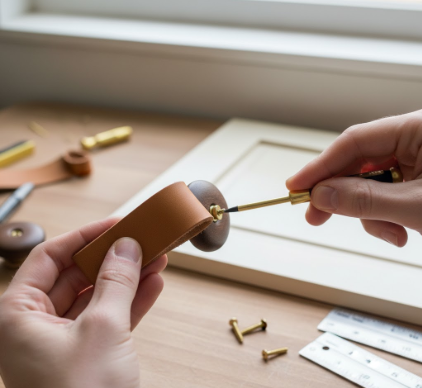
I used to think leather drawer pulls were one of those impossibly expensive design tricks that only people with interior designers could pull off.
Turns out, making your own leather cabinet pulls is actually one of the most straightforward DIY projects you can tackle on a weekend afternoon, and honestly, the results look like something you’d find in a boutique furniture store. The whole process takes maybe two hours if you’re moving slowly, and the materials cost roughly $20-30 depending on what you already have lying around. You’ll need vegetable-tanned leather—not the cheap stuff, because it won’t hold its shape—some leather conditioner, a rotary cutter or sharp scissors, a ruler, and screws that are long enough to go through both the leather and your drawer front. I’ve seen people try to use pre-finished leather and it just doesn’t work the same way; the vegetable-tanned variety develops this beautiful patina over time that makes each pull feel custom. The thickness matters too—aim for 3-4mm, because anything thinner feels flimsy and anything thicker becomes difficult to fold cleanly.
Anyway, here’s where it gets interesting. The shape you cut determines everything about the final aesthetic, and there’s no single “correct” approach. Some people go for simple loops, others prefer long straps that drape.
Measuring and Cutting Your Leather Strips Without Losing Your Mind
The measuring part is where most people get tripped up, but wait—maybe that’s because we overthink it. For a standard loop pull, you want strips that are about 7-8 inches long and roughly 3/4 inch wide, though I’ve seen widths ranging from 1/2 inch to a full inch depending on the look you’re after. The key is consistency: if your first pull uses a 7.5-inch strip, every other pull needs to match or your cabinets will look like a failed geometry experiment. I lay out all my leather on a cutting mat, mark everything with a pencil (chalk works too, but it rubs off too easily for my taste), and then cut in one session so the blade angle stays consistent. Here’s the thing—vegetable-tanned leather is surprisingly forgiving if you make small errors, but wildly unforgiving if you rush. One crooked cut and you’ll notice it every single time you open that drawer. Some tutorials tell you to use a hole punch to create the screw holes before you install anything, but I’ve found that drilling through the leather while it’s positioned on the drawer front gives you more precision, even if it feels slightly terrifying the first time.
The Folding Technique That Actually Makes Them Look Professional
This is where the magic happens, I guess. You fold each leather strip in half to create the loop, but before you screw it down, you need to condition the leather at the fold point—otherwise it cracks within a few weeks and you’ll be back at square one. I use a basic leather conditioner, work it in with my fingers until the leather feels slightly tacky, then let it sit for maybe 10 minutes. The leather becomes pliable enough to fold without creating a harsh crease line, which is the dead giveaway of amateur work. Once it’s conditioned, position the two ends of the strip against your drawer front, mark where the screws will go, and pre-drill tiny pilot holes through both the leather and the wood. If you skip the pilot holes, you risk splitting the wood or, worse, having the screw push the leather aside instead of going through it cleanly.
Then you just screw them in. Seriously, that’s it.
Why This Specific Approach Works Better Than What You’ll Find in Most Tutorials
Most online tutorials skip the conditioning step entirely, or they tell you to use olive oil, which is a disaster because it goes rancid and your cabinets will smell like a bad salad dressing within months. Leather conditioner is formulated to penetrate without breaking down, and it definately makes a difference in longevity. I’ve also seen people suggest using rivets instead of screws, which looks cool in photos but makes it nearly impossible to replace the pulls later if you change your mind or if the leather wears out. Screws give you flexibility. The other thing nobody mentions is that vegetable-tanned leather darkens significantly over time—what starts as a pale tan will become a rich honey color after six months of handling, and the oils from your hands actually contribute to that patina. If you want to speed up the process, you can rub the leather with a tiny bit of coconut oil after installation, but be sparing or it’ll feel greasy. Some people hate the idea of their hardware changing appearance, but I think that’s the entire point of using natural materials; the imperfection is what makes it feel human. Factory-made pulls look the same on day one and day 1,000, and there’s something exhausting about that level of static perfection. These pulls evolve, accumulate tiny scratches and color shifts, and after a year they feel like they’ve always been part of your space, which is either deeply satisfying or mildly unsettling depending on how you feel about change.








