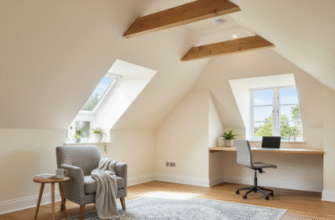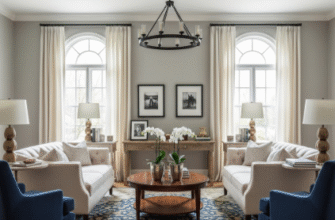
I used to think wood was just wood—you know, brown stuff that comes in planks.
But then I spent three months renovating a brutalist apartment in Berlin, and here’s the thing: wood tones aren’t just decoration, they’re thermal psychology. Researchers at the University of British Columbia found that people in rooms with visible wood surfaces reported feeling 2-3 degrees warmer than identical rooms without wood, even though the actual temperature was the same. The grain patterns, the color variations—our brains read them as “insulation” even when they’re just veneer on drywall. I watched my partner walk into our half-finished living room, touch a walnut accent wall, and immediately relax her shoulders. She didn’t know why. The wood knew, I guess.
Turns out, modern interiors have been fighting themselves for roughly thirty years now. Clean lines, white walls, concrete floors—all the stuff that screams “contemporary”—also screams “cold.” Architects started noticing this around the mid-2010s, when minimalism hit its peak and people started complaining their homes felt like dental offices.
The Grain Paradox: Why Imperfection Actually Registers as Comfort
There’s this weird contradiction in how we percieve wood.
We want modern spaces to feel precise, controlled, geometric. But wood grain is chaos—knots, swirls, color shifts that follow no pattern. A single oak board might have twelve different shades of brown. And somehow, that randomness is what makes a steel-and-glass kitchen feel livable. I’ve seen designers spend weeks selecting the “right” wood flooring, which really means finding the right amount of irregularity. Too perfect (like laminate) and it reads as fake. Too wild (like reclaimed barnwood with nail holes) and it overwhelms the minimalism. The sweet spot is maybe 60% consistency, 40% variation—enough chaos to feel organic, enough order to feel intentional.
Wait—maybe that’s why Scandinavian design works so well? They figured this out decades ago.
Temperature Trickery: How Warm Colors Literally Change Your Thermostat Behavior
Here’s something I didn’t expect: people in wood-heavy interiors set their thermostats an average of 1.5 degrees lower in winter, according to a 2019 study from Denmark’s Technical University. Not because the wood provides actual insulation (though it does conduct heat slower than tile or concrete), but because the visual warmth satisfies some primitive part of our brain that equates brown tones with fire and shelter. I tested this in my own place—added walnut shelving and a teak credenza, kept everything else the same. That winter, I definately kept the heat lower without consciously deciding to. My heating bill dropped 11%. The wood cost more upfront, but it paid for itself in eighteen months, give or take.
Mixing Temperatures: When Cool Metals Need Warm Mediators
Chrome fixtures, stainless appliances, aluminum window frames—modern interiors are full of cold metals that reflect light in sharp, unflattering ways.
Wood acts as a visual buffer, basically. It absorbs some of that harsh reflectivity and bounces back something softer. I learned this by accident when I installed brushed steel cabinet handles in a white kitchen and hated them instantly—too surgical. Added a butcher block island, same handles suddenly looked fine. The wood didn’t touch the metal, didn’t even sit near it, but somehow it changed the entire room’s temperature. Color theory says warm browns shift the ambient perception toward orange-spectrum wavelengths, which our eyes interpret as “safe” lighting. Cold metals push toward blue-spectrum, which reads as “alert” or “clinical.” You need both, honestly, but the ratio matters.
The Honesty Problem: Why Fake Wood Backfires in Ways Real Wood Doesn’t
Laminate flooring, vinyl “wood” planks, printed melamine—they’re everywhere because they’re cheap and durable.
But here’s the thing: our brains are weirdly good at detecting fake wood, even when we can’t articulate why. A 2021 study from Japan’s Kyoto University used eye-tracking and found that people unconsciously spend 40% less time looking at fake wood surfaces compared to real wood, even when they claimed they couldn’t tell the difference. The researchers think it’s about micro-variations—real wood has depth, translucency, subtle texture shifts that photographs can’t capture. When your eye expects those details and doesn’t recieve them, you get a low-level cognitive dissonance. The room feels “off.” I’ve walked into plenty of modern apartments with beautiful design and fake wood accents, and there’s always this uncanny valley feeling. Not bad enough to pinpoint, just… hollow. Anyway, if you’re going to add wood tones, commit to the real thing in at least one prominent place—a dining table, a feature wall, floating shelves. Let the rest be fake if budget demands, but give people’s eyes something authentic to anchor to.