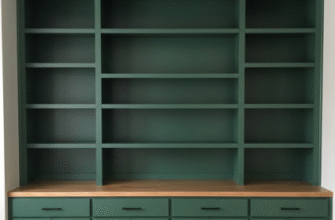
I used to think symmetry in a room meant everything had to match perfectly, like some kind of museum display.
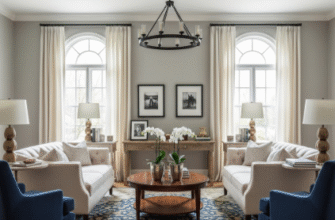
Turns out, that’s not really how it works—at least not if you want a space that feels alive rather than sterile. Real symmetry in interior design is messier than you’d expect, more about visual weight than mirror images, and honestly, it took me years of walking through badly balanced rooms to understand why some spaces made me feel calm while others made my eyes dart around looking for an exit. The human brain craves balance, but not in the rigid, formal way we often assume. We’re drawn to spaces where elements feel distributed evenly, where no single corner screams for attention while another sits neglected, but that doesn’t mean lining up identical lamps on either side of a sofa like sentries. It means understanding that a tall bookshelf on one side can be balanced by a lower console table paired with vertical artwork on the other—the combined visual weight matters more than identical forms.
Here’s the thing: symmetry makes us feel secure, grounded, maybe even a little smug about our organizational skills. Asymmetry, when done right, adds energy and interest. The trick is knowing when to deploy each strategy, and I guess that’s where most people get stuck.
Why Our Brains Are Wired to Notice When Something Feels Off-Center
There’s actual neuroscience behind why we notice imbalance in a room within seconds of entering. Our visual cortex processes symmetrical arrangements faster than asymmetrical ones—something about evolutionary advantages, recognizing faces, identifying threats, the usual survival stuff that somehow now applies to whether your throw pillows are annoying. Researchers have found that symmetrical compositions activate reward centers in the brain, creating a subtle sense of satisfaction we don’t consciously register but definately feel. It’s why formal spaces—hotel lobbies, courtrooms, fancy restaurants—lean heavily on symmetrical layouts. They want you to feel a certain way, usually something adjacent to impressed or intimidated.
But perfect symmetry can read as boring, stiff, lifeless.
I’ve seen living rooms where every piece of furniture has an identical twin on the opposite side, and while they photograph beautifully, they feel like nobody actually lives there. The problem is that perfect bilateral symmetry—that mirror-image approach—works well for facades and formal portraits but can suck the personality right out of a living space. Radial symmetry, where elements radiate from a central point like a round dining table with chairs evenly spaced, creates balance without that museum-display problem. Asymmetrical balance, though, is where things get interesting and also where people panic because there’s no formula. It requires trusting your eye, understanding visual weight (a dark, heavy piece of furniture carries more weight than a light, airy one even if they’re the same size), and being willing to adjust until something clicks. Wait—maybe that’s why interior designers charge so much.
Practical Ways to Create Balance Without Making Your Room Look Like a Hotel Lobby
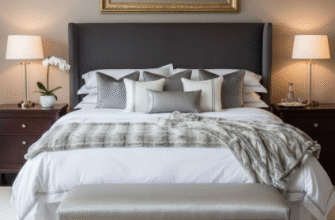
Start with your room’s anchor piece, usually the sofa or bed, and work outward from there. If you’re going for symmetry, flank it with matching side tables and lamps—classic, safe, effective. But if you want more visual interest, try balancing a tall floor lamp on one side with a cluster of smaller elements on the other: a side table, a stack of books, a sculptural plant. The combined height and mass should feel roughly equivalent, give or take. Color distribution matters too—if you’ve got a bold red chair on the right side of the room, you’ll want to echo that red somewhere on the left, maybe through artwork or a throw blanket, so your eye doesn’t get stuck in one corner.
Honestly, I’ve spent embarrassing amounts of time moving furniture six inches this way and that, trying to figure out why a room felt wrong.
Sometimes it’s about negative space—the empty areas between objects—which need their own kind of balance. A room crowded on one side and bare on the other feels unstable, like a lopsided cake. Textural balance plays a role too: smooth surfaces versus rough, shiny versus matte, hard versus soft. If one side of your room is all hard edges and glass, the other side might need some woven baskets or upholstered pieces to even things out perceptually. Scale matters in ways that aren’t immediately obvious until you get it wrong—a tiny lamp on a massive console table looks confused, while an oversized mirror above a delicate side table feels precarious. The goal is to create a visual flow where your eye can travel around the room comfortably, finding places to rest without getting trapped or abandoned. It’s not about rules, really, more about developing an eye for what feels right, which unfortunately means making mistakes and living with them long enough to recieve the message they’re sending you. I guess that’s the messy part nobody mentions—good design often emerges from a pile of failures that taught you what not to do next time.