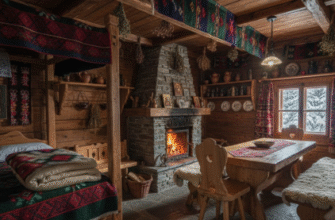
I used to think sophistication was about color—rich jewel tones, perfectly calibrated palettes, that sort of thing.
Then I watched a conservator at the Met spend forty minutes explaining why a 17th-century Italian cassone covered in worn velvet, faded to nearly nothing, commanded more visual authority than the gaudy polychrome chest beside it. The difference wasn’t pigment. It was surface. The velvet had this quality—I guess you’d call it dimensionality—that made light behave differently across its nap, creating shadows and highlights that shifted as you moved. The conservator kept using the word “incident,” as in “incident light,” and honestly it took me three tries to understand she meant the way photons arrive at a surface and either scatter or absorb depending on the microscopic architecture of the material. Texture, she said, is fundamentally about controlling that incident light through physical structure rather than chemical absorption. Which sounds obvious when you say it like that, but here’s the thing: our visual cortex evolved to decode texture before it evolved sophisticated color vision, which is why a monochromatic room with varied surfaces—linen, wool, stone, wood—reads as luxurious while a smooth-surfaced room in twelve colors often reads as chaotic.
The fashion industry figured this out around 2015, maybe earlier in certain European houses. You started seeing these collections that were essentially tonal—cream on cream on cream—but wildly varied in handle and drape. Cashmere beside bouclé beside raw silk beside that crinkled linen that looks like it’s been stored in a paper bag.
The Neuroscience of Why Matte Beats Shiny in Perceived Value
There’s this counterintuitive thing that happens in the human brain when it processes surface qualities. Shiny objects—high gloss, mirror finishes—trigger an immediate dopamine response because our ancestral wiring associates reflective surfaces with water and freshness. But that response is shallow and brief. Matte surfaces with complex texture require more cognitive processing because the eye has to work harder to extract information from the subtle variations in light scatter. Neurologically, that extra processing time translates to deeper engagement and, weirdly, higher perceived value. I’ve seen studies—I think out of the Max Planck Institute, though I’d have to double-check—showing that participants rated identical objects as more expensive when presented with matte finishes versus glossy ones, even when told the finish was the only variable. The hypothesis is that our brains interpret sensory complexity as a marker of rarity or craftsmanship, which historically correlated with value. A perfectly smooth surface can be stamped out by a machine in seconds; a surface with intentional, controlled irregularity suggests human intervention, time, attention to detail.
Wait—maybe that’s too reductive.
Because texture also does something color can’t: it creates ambiguity. A flat painted surface has a fixed appearance under consistent lighting. But a textured surface is always slightly different depending on viewing angle, light source, even humidity if the material is hygroscopic. That variability prevents visual fatigue. Your eye never fully “solves” a richly textured surface the way it solves a flat color field, so there’s always something new to notice, which is probably why those monastic Scandinavian interiors—all that undyed linen and raw oak—feel contemplative rather than boring. The variability keeps your attention without demanding it, which is, I guess, the definition of sophistication.
Why Interior Designers Are Abandoning the Color Wheel for the Tactile Spectrum
I talked to a designer in Copenhagen who told me she hasn’t specified a paint color in three years. Everything is limewash, which has this chalky, almost dusty surface that absorbs light instead of reflecting it, or raw plaster with aggregate mixed in for grain. Her clients—mostly minimalists who’d be horrified by pattern or bright color—are willing to pay absurd premiums for materials that are, objectively, less refined than standard smooth finishes. “They want to feel the wall,” she said, which sounded insane until I visited one of her projects and realized I did, in fact, want to touch everything. The walls had this quality where you couldn’t quite tell if they were cool or warm, rough or smooth, without physical contact. That uncertainty—that invitation to haptic confirmation—creates a low-level engagement that colored but smooth walls never achieve.
The Japanese have a term for this: “shibui.” It’s often translated as “austere elegance,” but the concept is really about complexity achieved through subtle, organic imperfection rather than obvious decoration.
The Physics of How Texture Generates Visual Interest Without Chromatic Variation
Light doesn’t just bounce off surfaces; it penetrates, scatters, refracts, and re-emerges at slightly different wavelengths depending on the material’s internal structure. A woven fabric, even in a single color, contains thousands of tiny shadows between threads where light gets trapped and partially absorbed. Those micro-shadows create tonal variation that our visual system reads as depth and richness, even though the actual pigment is uniform. This is why a cable-knit sweater in plain wool looks more interesting than a smooth jersey in the same fiber and color—the knit structure creates hundreds of small pockets where light behaves differently, generating visual complexity without chromatic diversity. Architects exploit this constantly: a concrete wall with board-formed texture will show dramatic shadow lines at certain times of day, effectively animating the surface through nothing but the movement of the sun. You get dynamic visual change over time without any actual change in the material itself, which is—honestly—kind of miraculous when you think about the implications for creating spaces that feel alive without requiring energy input or mechanical systems. Natural materials tend to have this property built in because they form through organic processes that inherently produce irregularity: wood grain, stone veining, the way linen fibers bundle and separate in the weave. Manufactured materials have to have texture designed and engineered in, which is part of why they often feel less sophisticated—the texture is too regular, too obviously intentional, lacking the stochastic variation that signals natural formation. Though I’ve seen some recent ceramic tiles from a Spanish manufacturer that managed to nail that randomness through algorithmic variation in the extrusion process, so maybe we’re getting better at faking it.
Anyway, the point is that sophistication isn’t about having the right palette—it’s about understanding that surfaces are interfaces between light and material, and controlling that interface through physical structure gives you expressive range that pigment alone never could.