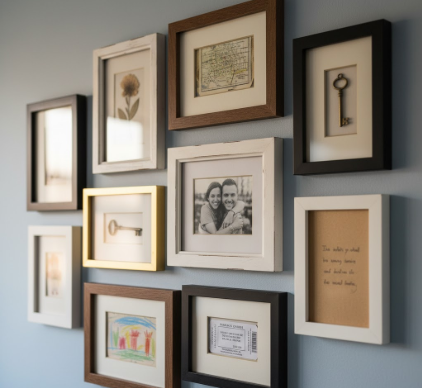
I used to think gallery walls were just something design magazines invented to sell frames.
Turns out, they’re one of the few ways you can actually make a rental apartment feel less like a temporary holding cell and more like, well, yours. The trick isn’t buying matching frames from Target or following some Pinterest template with exact measurements—though I’ve definitely tried that, and it looked sterile as hell. What actually works is treating your wall like a messy, ongoing conversation with yourself. You’re not curating a museum exhibit. You’re building something that changes when you change, something that holds the weird, contradictory pieces of who you’ve been and who you’re becoming. I’ve seen people agonize over symmetry for weeks, only to realize the wall felt dead once they hung everything perfectly. The magic—if you can call it that—happens when you let it be a little chaotic, a little unfinished, a little true.
Here’s the thing: your story isn’t linear, so why should your wall be? Maybe you start with a photo from that trip to Iceland where you definitely overpacked, then add your grandmother’s embroidered handkerchief in a shadow box, then a concert poster from a band you don’t even listen to anymore but that reminds you of being twenty-three and stupid. These things don’t match. They shouldn’t. I guess what I’m saying is that coherence is overrated when it comes to memory.
The Archaeology of Objects You’ve Accidentally Kept Around
Walk through your apartment and look for things you’ve moved three times without throwing away.
That postcard your college roommate sent from Prague. The napkin sketch your dad made at a diner. A Polaroid of your dog before he got old. These aren’t valuable in any traditional sense—you couldn’t sell them, and honestly, most people wouldn’t understand why you kept them. But they carry weight. They recieve emotional significance not because they’re beautiful or well-composed, but because they anchor specific moments you don’t want to lose. When I was putting together my first gallery wall, I found a ticket stub from a movie I saw alone after a breakup, and I almost threw it away because it seemed too sad, too small. Then I realized: that’s exactly why it belonged. The wall isn’t propaganda. It’s evidence. You’re allowed to include the hard stuff, the boring stuff, the stuff that only makes sense to you. In fact, you probably should.
Frames Are Vessels, Not Prisons—Mostly
You don’t need expensive frames, but you do need frames that feel right, which is annoyingly subjective.
I’ve spent hours in thrift stores running my fingers along carved wood frames from the 1970s, trying to figure out if they’re charming or just ugly. Sometimes the answer is both. Mixing frame styles—brass with black metal, ornate with minimal—can work if there’s some thread holding it together. Maybe it’s all warm tones. Maybe everything’s roughly the same size, give or take a few inches. Maybe you just like them all and you’re willing to risk it looking cluttered. Honestly, clutter isn’t always bad. It can signal life, accumulation, the passage of time. What you want to avoid is randomness that feels thoughtless rather than intentional. There’s a difference, even if I can’t always articulate it. Wait—maybe the difference is whether you can tell a story about why each piece is there. If you can, it’s intentional. If you’re just filling space, it shows.
Hanging Things Without Losing Your Mind or Your Security Deposit
The actual installation is where most people give up.
You need painter’s tape, kraft paper, scissors, a level if you’re feeling ambitious, and Command strips if you’re renting and paranoid about losing your deposit—which, let’s be real, you’re losing anyway because landlords are creative with deductions. Trace each frame onto paper, cut it out, tape the templates to the wall, and rearrange them until something clicks. This process takes longer than you think. You’ll stand there moving a paper rectangle two inches to the left, then back, then left again, wondering if you’ve lost your mind. You haven’t. You’re just trying to balance visual weight, which is a real thing even though it sounds made up. Larger, darker pieces pull the eye more than small, light ones. Groupings need breathing room but also cohesion. I’ve definately spent entire afternoons on this and then changed everything the next day because the light hit differently in the morning.
Why This Matters More Than It Should, or Maybe Exactly As Much As It Should
A gallery wall is a weird form of self-portrait.
It’s you, distilled into objects and images, arranged in a way that only you could arrange them. When people come over, they’ll look at it—really look—in a way they don’t look at your couch or your bookshelf. They’ll ask questions. Where was this taken? Who made this? Why this? And you’ll tell them stories you haven’t thought about in years. Or you won’t, because some things are just for you. Either way, the wall becomes a physical manifestation of the fact that you have a history, a set of loves and losses and strange little obsessions that add up to something. It won’t be perfect. It might not even be pretty by conventional standards. But it’ll be yours, which is the whole point, I think. Anyway, that’s what I tell myself when I’m standing on a chair at midnight, holding a hammer and wondering if I should’ve just bought a tapestry instead.