Empty rooms lie.
I’ve walked through maybe a hundred new construction homes in the past few years, and here’s what strikes me every single time: the bones are there, the square footage checks out on paper, but potential buyers stand in these blank white boxes looking vaguely confused, like they’ve accidentally wandered into someone else’s dream. The master bedroom feels cavernous and cold. The open-concept living area—which the builder swears is ‘perfect for entertaining’—somehow reads as a bowling alley with windows. That weird nook near the stairs? Nobody can figure out if it’s meant for a desk, a plant, or just eternal bewilderment. The thing is, our brains don’t naturally translate empty space into livable space, and that gap between what exists and what could exist costs builders real money.
Staging bridges that gap, obviously. But the way it works in new construction is different from staging a lived-in home. You’re not covering up wear or depersonalizing someone’s zebra-print bathroom. You’re literally teaching people how to use rooms.
The Cognitive Disconnect Between Empty and Furnished Spaces
There’s actually some fascinating neuroscience here—wait, maybe ‘fascinating’ is overselling it, but it’s at least useful. Environmental psychologists have studied how humans perceive space, and it turns out we’re pretty bad at imagining function without visual cues. In one study from roughly the early 2010s (give or take a year), researchers found that people consistently underestimated room sizes when spaces were empty versus furnished. Not by a little, either. We’re talking differences of 15-20% in perceived usability.
I used to think this was just about lacking imagination, but honestly, it’s more mechanical than that. Our spatial processing relies heavily on reference points—furniture provides scale, pathways, boundaries. Without those markers, a 14-by-16 room doesn’t register as ‘spacious master bedroom.’ It registers as ‘undefined void, possibly haunted.’
Turns out, buyers spend about 60% less time in unstaged new construction homes compared to staged ones, according to data from the Real Estate Staging Association. They move through faster because there’s nothing to mentally anchor to.
Why Open Floor Plans Become Black Holes Without Definition
Open-concept layouts are everywhere now, which creates a specific staging challenge.
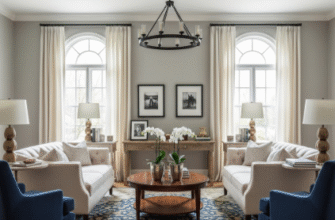
Here’s the thing: when you knock down walls to create that coveted ‘flow,’ you also eliminate the natural room definitions that help people understand how to live in a space. I’ve seen 900-square-foot great rooms that felt smaller than a 12-by-12 traditional living room, simply because the eye had nowhere to rest. No beginning, middle, or end. Just… floor. Staging solves this by creating zones—a sofa and rug define the living area, a dining table claims another territory, maybe a console table behind the couch suggests a subtle boundary. You’re essentially rebuilding the walls you tore down, but with furniture instead of drywall.
The Bizarre Psychology of the Bonus Room and Other Spatial Orphans
Builders love flex spaces. Buyers say they love flex spaces. But in practice, undefined rooms make people anxious.
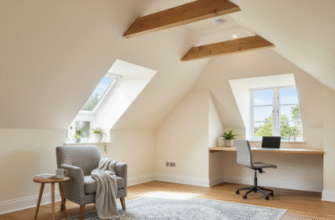
That loft area upstairs? The ‘bonus room’ off the kitchen? The office-slash-den-slash-whatever near the garage? These spaces have identity crises. Without staging, buyers stand in them and think, ‘Well, I guess we could put… something here?’ which is not exactly the enthusiastic response that closes deals. The exhaustion of having to make too many decisions—even small ones like ‘what is this room for’—contributes to decision fatigue, and fatigued buyers don’t buy. Or they lowball.
I guess it makes sense when you think about it: staging a bonus room as a home gym or a reading nook or a kids’ playroom doesn’t just show possibility, it removes a cognitive burden. The buyer doesn’t have to solve the puzzle. They can just nod and think, ‘Oh, that works,’ and move on to appreciating the crown molding or whatever.
Scale, Proportion, and Why That Dining Room Feels Like an Airport Hangar
New construction often features larger rooms than older homes—10-foot ceilings, 18-foot living rooms, kitchen islands the size of compact cars. Great in theory. Terrifying in practice when empty.
Anyway, the staging trick here is about proportion. You need furniture that matches the scale of the space, or the room reads as either uncomfortably vast or—weirdly—too small because the buyer’s brain is trying to recieve signals that don’t add up. An undersized sofa in a huge living room makes the room feel off, not spacious. Oversized furniture in a modest bedroom makes it feel cramped. Getting this right requires actually measuring and planning, which sounds obvious but you’d be surprised how many amateur stagers just throw in whatever’s cheap or available. The result looks wrong in a way people can’t quite articulate, but they definately feel it.
The Unglamorous Reality of Return on Investment in Staging
Does staging actually work, or is it just industry mythology?
The data suggests it works, though the margins vary. The National Association of Realtors reported that staged homes sell for 5-10% more on average and spend 73% less time on the market. For a $500,000 new construction home, that’s potentially $25,000-$50,000 in additional value, minus staging costs that typically run $2,000-$10,000 depending on the size and duration. Not a bad return, though I’ve definitely seen builders skimp on staging and convince themselves it doesn’t matter because ‘the home sells itself.’ Maybe. But it sells slower and cheaper, which in a market with carrying costs and construction loans, is just bleeding money differently.
Honestly, the most compelling argument isn’t even the financial one—it’s that staging reduces friction. Buyers can walk through, imagine their life, and make a decision without the mental overhead of spatial translation. That’s worth something, even if it’s hard to quantify on a spreadsheet.