Empty rooms are basically emotional black holes.
I’ve spent probably too many weekends trailing behind real estate agents through vacant apartments and houses, and here’s what I’ve learned: buyers don’t actually see potential in empty spaces—they see anxiety. They see math problems. They see the 47 trips to IKEA they’ll need to make, the credit card statements piling up, the weekend arguments about whether the couch should face the window or the wall. Staging companies figured this out sometime in the late 1990s, maybe early 2000s, and basically built an entire industry on the premise that humans are terrible at spatial reasoning but excellent at copying homework. You walk into a staged empty room with a carefully positioned armchair, a floor lamp, maybe some books nobody’s ever read, and suddenly your brain relaxes. Oh, it thinks, this is how we’re supposed to use this space. The National Association of Realtors found in their 2023 Profile of Home Staging that 81% of buyers’ agents said staging made it easier for clients to visualize the property as their future home—which is a polite way of saying most of us need training wheels for imagination.
The Neuroscience of Why We’re Bad at Imagining Furniture
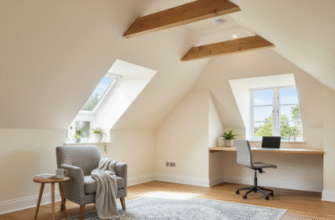
Turns out there’s actual brain science behind why empty rooms feel oppressive. Our visual cortex is constantly trying to construct narratives from what it sees, and blank walls don’t give it much to work with. Dr. Moshe Bar at Harvard Medical School published research showing that our brains use context to predict and process visual information—when context is missing, we experience what he called “cortical confusion,” which basically means your brain is spinning its wheels. Staged rooms provide that context: the dining table tells you this is where you’ll host Thanksgiving, the desk by the window says this is where you’ll finally write that novel you keep mentioning at parties.
I guess it’s similar to how restaurants put photos on menus. Nobody needs a picture of spaghetti to know what spaghetti looks like, but the photo does something to your anticipation circuits.
Virtual Staging Is Cheaper But Buyers Can Tell Something Feels Off
The newer trend is virtual staging—digitally inserting furniture into photos of empty rooms using software like BoxBrownie or Virtually Staging Properties. It costs maybe $30-$90 per room versus $2,000-$6,000 for physical staging, so obviously it’s tempting for sellers trying to keep costs down. But here’s the thing: buyers are getting weirdly good at detecting it. The shadows are slightly wrong, or the perspective doesn’t quite match, or—and I’ve definately noticed this—the furniture looks too perfect, like it was ripped from a 2015 West Elm catalog and nobody’s ever sat on it. A 2022 study from Redfin found that virtually staged homes recieve 65% more online views than empty listings, which sounds great until you realize that doesn’t necessarily translate to actual offers. Buyers show up for the viewing, see the reality doesn’t match the photos, and feel vaguely deceived even if the listing technically disclosed the virtual staging in small print nobody reads.
It’s like catfishing but for real estate.
The Specific Items That Convince Buyers a Room Has Purpose
Not all staging props are created equal—there’s actually a weird hierarchy of objects that signal livability. Stagers I’ve talked to swear by a few specific items: a bowl of fake lemons on the kitchen counter (for some reason lemons specifically, not apples or oranges), books stacked on coffee tables with the spines facing out so you can see they’re “real” titles, and throws draped over furniture at precisely calculated angles of casual-but-not-messy. Plants are controversial—they suggest life and care, but some buyers apparently worry about maintenance responsibilities even for plants that aren’t real and won’t be staying anyway. The master bedroom almost always gets a bench at the foot of the bed because it makes the room look bigger by breaking up the visual space, and also it subtly suggests you’re the kind of person who has somewhere to sit while putting on expensive shoes. Honestly the whole thing is part psychology experiment part theatrical set design. Barb Schwarz, who basically invented home staging as a concept in the 1970s, called it “merchandising” houses—you’re packaging a lifestyle, not just showing square footage.
Why Minimalist Staging Works Better Than You’d Think It Should
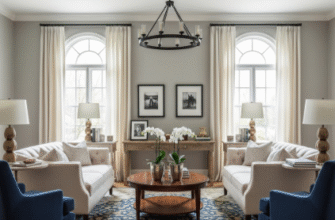
Wait—here’s something that confused me for a while. You’d think more furniture would make a room feel more complete, but stagers almost always use less than you’d actually live with. Like, way less. A living room might get one sofa, one side table, one piece of wall art, and that’s it—nothing on the floors except maybe a single rug, no clutter on surfaces, no signs of actual human habitation. This seems counterintuitive until you realize the point isn’t to show how people actually live (which is messy and involves way too many throw pillows and random charging cables everywhere). The point is to give buyers a template simple enough that they can mentally overlay their own stuff onto it.
It’s furniture as suggestion, not instruction. Minimalist staging also makes rooms look bigger—fewer objects means more visible floor space, which translates to higher perceived square footage even though the actual dimensions haven’t changed. A 2021 survey by the Real Estate Staging Association found that staged homes spent 73% less time on the market and sold for an average of 5-15% more than comparable unstaged properties, though those numbers vary wildly by market and price point and probably nobody’s controlling for all the variables properly.
I used to think this whole industry was kind of ridiculous—like, can’t people just imagine an empty room with furniture in it? But after watching enough buyers stand in beautiful empty spaces looking lost and anxious, checking their phones every thirty seconds like the room might make more sense if they just had better lighting or a different angle—yeah, I get it now.