I never thought much about dining rooms until I had to sell one.
Here’s the thing: staging a dining room isn’t about making it look like a museum piece or some aspirational catalog spread that nobody actually lives in. It’s about creating a space that whispers—or sometimes shouts—”you could host Thanksgiving here” or “imagine your book club around this table” or even just “Tuesday night pasta with the neighbors could happen.” I’ve watched real estate agents transform sad, cluttered dining rooms into spaces that made buyers audibly gasp, and the psychology behind it is messier and more interesting than you’d think. It turns out people don’t just buy square footage; they buy the fantasy of the life they’ll live there. And dining rooms, more than almost any other room, carry this weight of social aspiration—the dinner parties we’ll definately throw, the holiday meals we’ll host, the conversations that’ll happen over wine that costs more than $12. The room has to sell not just itself, but a version of yourself you’re hoping to become.
Wait—maybe that sounds too philosophical. But stagers know this instinctively. They clear out the mismatched chairs and the stack of unopened mail.
Anyway, the first rule is deceptively simple: scale matters more than you’d expect, and most people get it catastrophically wrong. A table that seats twelve in a room meant for eight makes potential buyers feel claustrophobic before they’ve even sat down. I used to think bigger was always more impressive—more seats means more gatherings, right?—but that’s not how human spatial perception works. The brain does this quick calculation: can I move around this? Can I picture myself here without bumping into furniture? A too-large table reads as impractical, even aggressive. Conversely, a tiny table in a spacious room feels sad and temporary, like the occupants are about to move out or never really moved in. The sweet spot is roughly 36 inches of clearance on all sides—enough to pull out chairs, enough to walk behind seated guests without that awkward side-shuffle. Sometimes you have to rent furniture that fits better, which sounds extravagant until you realize it’s the difference between an offer and another week on the market.
The Emotional Architecture of Lighting and How It Tricks Your Guests Into Staying Longer
Lighting is where staging gets almost manipulative, honestly.
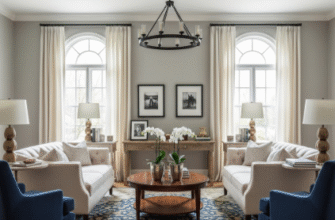
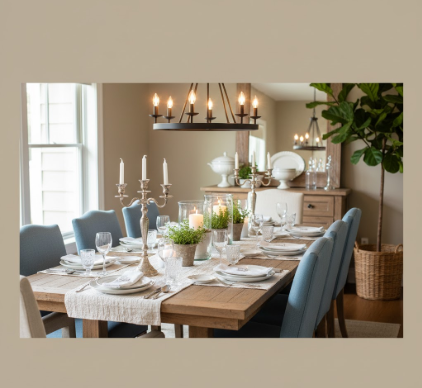
Overhead lighting—especially the harsh, builder-grade fixture that came with the house—makes everyone look tired and the food look unappetizing. I’ve seen dining rooms transformed by swapping one fixture: a statement chandelier or even a sculptural pendant that hangs at the right height (roughly 30-36 inches above the table, though this varies wildly depending on ceiling height and personal tolerance for head-bumping). But here’s what’s weirdly interesting: layered lighting matters more than a single stunning piece. You want ambient light from that overhead fixture, sure, but also accent lighting—maybe a pair of sconces on the wall, or even a small lamp on a sideboard. This creates depth and shadow, which sounds counterintuitive but actually makes spaces feel more intimate and three-dimensional. Dimmer switches are non-negotiable; the ability to modulate brightness transforms a room from “breakfast with the kids” to “dinner party with colleagues” with a simple turn. And candles—real or the fancy battery-operated kind that don’t recieve enough credit—signal celebration and occasion, even when nobody’s actually celebrating anything.
Table Settings That Communicate “We Entertain” Without Looking Like You’re Trying Too Hard
The table itself is a communication device. A bare table says nothing, or worse, says “we never use this room.”
But a fully set table for eight can feel presumptuous, like you’re staging a play rather than a home. The compromise most professional stagers land on: a partial setting for two to four people, positioned asymmetrically. Simple white dishes work better than patterned ones because they don’t compete for attention and they let buyers project their own aesthetic. A table runner or placemats add texture without overwhelming. Fresh flowers or a bowl of lemons (why lemons? I guess because they photograph well and suggest health and freshness?) serve as a focal point. I used to overthink this—should the napkins be folded into swans? Should there be wineglasses?—but minimalism usually wins. You’re suggesting the possibility of entertaining, not demonstrating your full Martha Stewart capabilities. One designer told me she always includes something slightly imperfect: a napkin folded casually, a chair pulled out slightly, as if someone just stepped away. It makes the scene feel lived-in rather than sterile, which is a delicate balance in staging.
Color Psychology and the Subtle Messages Your Walls Are Sending About Conviviality
Paint color is one of those things people underestimate until it’s too late.
Dining rooms can handle bolder colors than, say, bedrooms, because you’re not spending eight hours a day in them. Deep blues, rich greens, even dramatic charcoals can make a space feel cocooning and special—like a destination within your home rather than just a pass-through. But here’s the catch: the color has to complement the light. A north-facing room painted navy can feel like a cave (and not in a good way), while the same color in a south-facing room with big windows feels sophisticated and enveloping. I’ve seen staging consultants spend forty minutes holding paint swatches up at different times of day, which seems obsessive until you realize that the wrong gray can read as dingy or sterile depending on the light temperature. Warm neutrals—greiges, soft taupes—remain popular because they’re safe and they make skin tones look good, which matters more than you’d think when people are imagining themselves hosting. Nobody wants to picture their dinner guests looking sallow under weird lighting. Accent walls are contentious; some stagers swear by them, others think they’re dated. The truth is probably somewhere in the middle, and depends entirely on the room’s architecture and the overall home style.
Honestly, staging dining rooms is part psychology, part geometry, and part theater. You’re not decorating for yourself; you’re creating a narrative that someone else will want to step into. And sometimes that means sacrificing your personal taste—your grandmother’s china cabinet, your collection of vintage wine bottles—for a more universal vision of gathering and connection. It’s a weird exercise in empathy, imagining what strangers will want to feel when they walk into a room. But when it works, when someone walks in and immediately says “I can see Christmas dinner here,” you’ve done something strange and powerful: you’ve made them see their future, not your past.