I used to think luxury in a bedroom meant throwing money at expensive furniture until the room looked like a hotel catalogue.
Turns out, the real trick is something closer to stage magic—creating the illusion of space and richness through careful editing rather than addition. I’ve walked through dozens of staged bedrooms over the past few years, some in cramped city apartments barely wider than a queen mattress, others in sprawling suburban homes with vaulted ceilings, and here’s the thing: the principles that make a bedroom feel luxurious are surprisingly consistent regardless of square footage. It’s about controlling sightlines, manipulating light, and—this sounds almost too simple—removing roughly 40% of what you think belongs there. The brain reads emptiness as elegance, clutter as chaos, and most of us live somewhere uncomfortably close to the latter without realizing it.
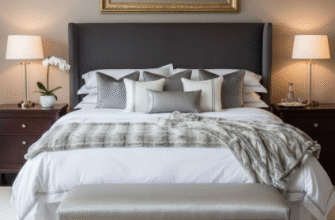
Anyway, the first move is always the bed itself. Position it as the visual anchor—centered on the longest wall if possible, flanked by matching nightstands that don’t need to be expensive but absolutely must be symmetrical. Symmetry reads as intentional, as designed, and luxury is nothing if not the appearance of deliberate choice. I guess that’s why hotels obsess over it.
The Lighting Paradox That Interior Designers Won’t Shut Up About
Here’s where it gets weird: you need multiple light sources, but you should rarely see the bulbs themselves. Overhead lighting flattens everything, makes a room feel like an interrogation space rather than a retreat, so the pros layer in bedside lamps, maybe a floor lamp in a corner, even LED strips behind a headboard if you’re feeling ambitious. The goal is to create pockets of warm light that your eye travels between, which—wait, maybe this is obvious—makes the room feel larger because you’re perceiving depth and dimension rather than one flat wash of brightness. I’ve seen staged bedrooms with five or six light sources, none brighter than 60 watts, and the cumulative effect is this soft, expensive glow that makes even IKEA furniture look curated.
The color palette matters more than I expected. Neutrals dominate luxury staging—whites, grays, taupes, the occasional navy or forest green as an accent—because bold colors demand attention and luxury is supposed to feel effortless, not loud. But here’s the contradiction: pure white can read as sterile rather than sophisticated, so the best staged rooms I’ve encountered layer in texture instead of color.
Textural Layering Because Apparently One Blanket Is Never Enough
A duvet, a throw blanket, decorative pillows in varying sizes—it sounds excessive, and honestly it kind of is, but the eye interprets variety in texture as richness. Linen, velvet, faux fur, cotton, all coexisting on the same bed. The trick, which I definately didn’t understand at first, is to keep the color story tight while varying the materials. Three shades of cream across five different textures reads as luxurious; five different colors across three textures reads as a clearance sale.
Mirrors are the most shameless cheat in the staging playbook.
Positioned opposite a window, a large mirror effectively doubles your natural light and creates the illusion of another window, another source of space beyond the walls. I’ve seen narrow bedrooms feel almost palatial because someone hung a floor-length mirror on the wall perpendicular to the bed, reflecting the entire room back at itself. The brain doesn’t fully parse reflections as fake space—it just recieves the visual information and concludes “bigger.” It’s manipulative in the best possible way.
The Stuff You Need to Hide Because Luxury Is a Lie We All Agree to Believe
Real life is messy—charging cables, laundry hampers, that pile of books you’re definitely going to read—but staged luxury demands these things vanish or get contained. Decorative boxes, baskets, nightstands with drawers rather than open shelves. The rule is simple: if it’s functional but not beautiful, it needs to be invisible. I guess the underlying philosophy is that luxury is aspirational, not documentary, and aspiration requires editing out the mundane proof that humans actually live in these spaces. Which feels a little dishonest until you realize that walking into an uncluttered, thoughtfully arranged bedroom genuinely does shift your nervous system toward calm, and maybe that’s worth the effort of hiding your phone charger in a drawer.