I used to think Spanish colonial architecture was just about grand cathedrals and whitewashed walls.
Then I spent three weeks in Asunción, wandering through neighborhoods where the air smells like tereré and lapacho blossoms, and I realized—wait—Paraguayan interior design is something else entirely. It’s this wild fusion where baroque Spanish columns meet Guaraní ñandutí lacework, where European symmetry collides with indigenous cosmology in ways that shouldn’t work but somehow do. The thing is, Paraguay spent centuries isolated from the rest of South America, trapped between hostile neighbors and its own geographical remoteness, which meant colonial styles evolved diferently here. Spanish Jesuits arrived in the 1600s, built their missions, brought their Renaissance ideals—but they were working with Guaraní craftspeople who had their own ideas about space, pattern, and what a home should feel like. The result? Interiors that confuse art historians but make perfect emotional sense when you’re actually sitting in them.
Here’s the thing: you can’t understand these spaces without understanding ñandutí. This spider-web lace technique, passed down through Guaraní women for generations, shows up everywhere—not just in textiles but in the very logic of how rooms are organized. Circular patterns radiating from a center point. I’ve seen dining rooms in colonial-era homes where the furniture arrangement mirrors ñandutí mandalas, where the table sits like the center of a web and everything else spirals outward.
Where Jesuit Baroque Meets Guaraní Geometry in Unexpected Ways
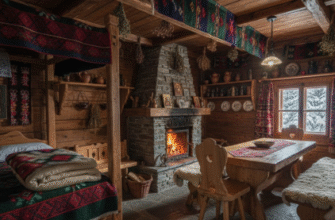
The Jesuits brought their love of ornamentation, their gilt frames and religious iconography, their obsession with vertical lines that draw the eye toward heaven. But Guaraní cosmology is horizontal—it’s about connection to earth, to community, to the flat expanse of the Chaco. So Paraguayan interiors became this compromise: high ceilings with exposed wooden beams (Spanish), but those beams carved with indigenous motifs—serpents, jaguars, geometric patterns that represent agricultural cycles. Wall niches designed for Catholic saints, sure, but surrounded by earthtone pigments made from local clay, in colors the Guaraní had been using for pottery centuries before any European arrived. The floors tell the story best, actually. Red tile (Spanish) laid in patterns that mirror pre-Columbian textile designs (Guaraní). It’s disorienting until it isn’t.
Honestly, the furniture is where things get really interesting.
Hamacas, Heavy Wood, and the Spatial Politics of Post-Colonial Living Rooms
Every traditional Paraguayan interior I’ve visited—from humble rural homes to restored colonial mansions in Yaguarón—features this same spatial tension. You’ll see massive Spanish-style wooden chairs, dark and formal, the kind designed to communicate authority and permanence. But right next to them? Guaraní hamacas, woven from cotton or carandá palm fiber, strung between posts in a way that completely undermines the European furniture’s seriousness. The hammock says: comfort over hierarchy, flexibility over rigidity, indigenous practicality over colonial pretension. And people actually use both, sometimes in the same conversation—shifting from the formal chair when discussing business to the hamaca when the talk turns personal. It’s like the room itself is bilingual. The color palettes follow this same hybrid logic: Spanish colonial interiors typically favored whites, deep blues, gold accents. Guaraní aesthetics preferred earth tones, ochres, terracottas, the occasional vivid red from urucum seeds. Paraguayan interiors somehow incorporate all of it, often in the same room, which should create visual chaos but instead produces this warm, layered richness. I guess it makes sense—when two cultures occupy the same space for four hundred years, give or take, they stop being separate and start being something new. Not fusion, exactly. More like coexistence with blurred edges, where neither element fully dominates and the tension itself becomes the design principle.
What strikes me most is how unapologetic it all is—no attempt to resolve the contradictions or smooth them over into some coherent aesthetic philosophy.
These interiors just exist, imperfect and vital, holding contradictions the way Paraguay itself does: stubbornly bilingual, historically isolated yet culturally hybrid, forever caught between competing visions of what a home—or a nation—should be.