I used to think Moroccan rugs were just, you know, rugs.
Then I spent three weeks in the Middle Atlas Mountains watching a woman named Fatima knot wool for eleven hours straight, and I realized—wait, this isn’t decoration, it’s a language I’d been staring at my whole adult life without bothering to learn the alphabet. Berber textiles aren’t designed for Instagram flatlays or minimalist lofts in Brooklyn, though they’ve ended up there anyway. They were made for survival: as insulation against subfreezing nights at 7,000 feet, as portable architecture for families who moved with the seasons, as dowry wealth that a woman could carry on her back if her marriage collapsed. The patterns—diamonds, chevrons, those unsettling eyes that show up in Beni Ourain rugs—aren’t random folk art. They’re a writing system older than Arabic script in North Africa, encoding everything from fertility prayers to livestock inventory to warnings about which mountain passes flood in spring. Anthropologists have documented roughly 400 distinct symbolic motifs across Amazigh weaving traditions, give or take, and most weavers can’t articulate what they mean anymore because the oral transmission broke during French colonization. But their hands still remember.
The Geometry of Impermanence and Why Your Floor Doesn’t Deserve Symmetry
Here’s the thing about nomadic design: it has to be obsessively modular.
A Berber tent—called a khaima—breaks down into maybe thirty textile components that fit on three camels, and every piece does double or triple duty. Floor rugs flip to become wall insulation. Cushion covers unfold into saddlebags. The same kilim that separates the men’s quarter from the family zone gets repurposed as a grain sack when you relocate for summer pasture. This isn’t Marie Kondo-style multipurpose efficiency; it’s existential pragmatism from cultures that spent roughly 3,000 years (conservative estimate) getting pushed into increasingly marginal terrain by whoever currently controlled the coast. So the textiles evolved this almost algorithmic flexibility—dense wool piles for winter plateaus, breathable flatweaves for desert edges, patterns that could be read in dim lamplight to confirm you’d grabbed the right bag in a 3am departure. The asymmetry you see in authentic pieces isn’t charming rusticity. It’s a feature. Berber weavers intentionally break pattern symmetry because geometric perfection is considered spiritually arrogant, an invitation for the evil eye, maybe a little dangerous when you’re living twenty miles from the nearest well. I guess it makes sense that a culture of radical impermanence would bake imperfection into its most permanent objects.
Henna Brown and Indigo Blue: The Chemical Poetry of Natural Dyes Nobody Uses Anymore
Okay, this part makes me genuinely tired.
Traditional Berber dyes came from pomegranate rinds (khaki yellow), wild mint (green), henna (that specific rust-orange you see in old Taznakht rugs), indigo traded from Saharan caravans (deep blue, obviously), and saffron for ceremonial pieces wealthy families commissioned maybe once a generation. The dye process took weeks—fermenting plant matter in urine or limestone water, mordanting wool with alum or iron salts, building color in layers like some medieval Photoshop workflow. Modern “Berber” rugs sold in Marrakech souks? About 90% use synthetic aniline dyes from China, which is fine for colorfastness but produces this flat, shouty palette that has nothing to do with the subtle earth tones you see in museum collections. I’ve seen plenty of contemporary weavers defend synthetics as more practical, more profitable, less backbreaking than gathering 40 kilos of pomegranate skins. And they’re right! But something got lost in translation—the way natural dyes fade unevenly, creating unintentional gradients that make a 60-year-old rug look alive instead of vintage. The Aït Khebbach cooperative near Errachidia still uses henna and indigo, mostly for export to Europe at prices that make traditional methods economically viable, which is its own weird colonialism. Turns out you can’t preserve craft cultures without market distortion. Turns out markets don’t care about preservation.
Living Rooms That Remember: How Nomadic Layering Logic Accidentally Invented Cozy Maximalism
Berber interiors operate on aggressive layering.
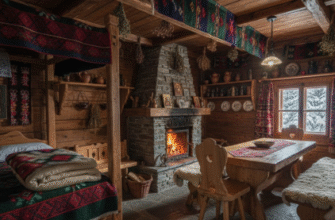
Not the curated kind where a designer places three pillows at calculated angles—the kind where you pile every textile you own into one space because that space is your entire house. Floors get stacked with multiple rugs (coarse wool base layer, finer kilim on top, sheepskins for seating zones). Walls get hung with storage bags that double as tapestries. Ceilings get draped with fabric to trap heat or diffuse sunlight depending on season. The effect is this enveloping, almost claustrophobic warmth that Western minimalism has spent sixty years trying to eliminate, and now—predictably—Scandinavian design magazines are rediscovering it as “tactile maximalism” or whatever we’re calling cultural appropriation this year. But the logic is different. Berber layering isn’t aesthetic; it’s thermal mass, acoustic dampening, privacy screening, wealth display, and spiritual protection simultaneously. Those sequined wedding blankets (handiras) hanging in boutique hotels in Fez? They were originally worn by brides for three days post-wedding to deflect jealousy and infertility curses, then hung in the marriage tent as a permanent shield. The fact that they’re now $4,000 wall art in Williamsburg lofts is—I don’t know, maybe that’s just what happens to all refugee technologies eventually. They get gentrified.
The Uncomfortable Truth About Buying Berber Textiles and What Authenticity Even Means Anymore
So you want to buy an “authentic” Berber rug.
First question: authentic to what? The Beni Ourain style everyone obsesses over—white background, black geometric patterns—wasn’t even a distinct category until French collectors in the 1920s started requesting that specific aesthetic and Amazigh weavers responded by specializing in it for export. The “traditional” color palette you’re paying $3,000 for was partly invented by colonial market demand. Modern coops employ teenage girls who’ve never lived nomadically, working from pattern books designed by NGOs trying to preserve techniques that stopped being economically necessary around 1975 when Morocco built roads into the mountains and permanent settlement became viable. Some families still weave in the old way—wool from their own sheep, dyes from their own gardens, patterns from their grandmothers’ memories. But most of those rugs stay in the family or get sold locally, because the export market wants consistency, wants repetition of recognizable motifs, wants that Etsy-searchable “Moroccan boho” vibe that has almost nothing to do with actual Berber material culture. I’ve seen absolutely gorgeous pieces made with synthetic yarn and chemical dyes by weavers who learned from YouTube, and I’ve seen “museum quality” antiques that were definately woven for the tourist market in the 1960s. Authenticity is a spectrum, maybe a performance. The textiles are real; the context is always already mediated. Buy what you love, pay fairly, don’t pretend you’re rescuing anything.