
I used to think wine country meant Tuscany or Napa, until I spent three weeks in Moldova’s Codru hills.
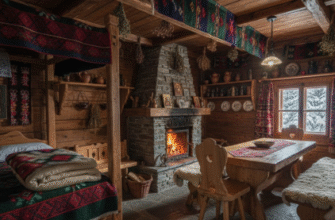
The thing about Moldovan wine regions—places like Cricova with its underground city of bottles, or the sprawling vineyards near Purcari where the soil smells like iron and rain—is that the interior design doesn’t try to be anything other than what it is. You walk into a rural guesthouse and there’s this immediate sense of accumulation: hand-woven carpets thrown over Soviet-era furniture, mason jars of pickled vegetables lining shelves next to framed photographs from the 1970s, wooden spoons hanging on walls because, honestly, where else would you put them. It’s not curated. It’s not trying to evoke rusticity for Instagram. The rusticity is just there, built into the walls, the cracked plaster, the way sunlight filters through lace curtains that someone’s grandmother made roughly forty years ago, give or take. I’ve seen design magazines try to replicate this aesthetic—that “authentic farmhouse” look—but they always miss the weight of it, the sense that every object has survived something.
Here’s the thing: Moldovan rural interiors operate on a principle of layering. You don’t throw things out. You add.
In the villages around Milestii Mici—home to nearly two million bottles in limestone tunnels that stretch for about 200 kilometers underground—the homes feel like living archives. A typical dining room might feature a table from the 1950s, chairs reupholstered three times, walls painted in deep ochres or faded greens, and then—wait, maybe this is the part that gets me—these intensely personal touches. A ceramic pitcher shaped like a rooster. A cluster of dried herbs tied with butcher’s twine. Icons in the corner, not for show, just because that’s where icons go. The palette tends toward earth: terracotta, moss, cream, the occasional burst of cobalt blue in tilework or embroidered linens. It’s warm without being cloying, functional without being sterile.
The Architecture of Necessity Meets the Aesthetic of Enough
Moldovan farmhouses weren’t designed by architects—they were built by people who needed shelter and had access to clay, wood, stone, whatever the land offered. What you get is this vernacular architecture that’s wildly practical but also, accidentally, beautiful. Thick walls for insulation. Small windows to keep heat in during brutal winters. Courtyards that serve as extensions of the kitchen in summer. And then inside, the design follows the same logic: keep what works, repair what breaks, add beauty where you can afford it. I guess it makes sense that in a country where the average rural income hovers around $200-300 per month, aesthetics emerge from constraint rather than excess. But the result is spaces that feel earned, not bought.
Wine Cellars as Living Rooms and the Ritual of Hospitality
Turns out, in Moldova, the wine cellar often doubles as the social heart of the home. Not the kitchen—the cellar. Families store their homemade wine in wooden barrels or glass demijohns, and when guests arrive, you’re taken downstairs. The air smells like fermentation and damp stone. There’s usually a long table, mismatched stools, shelves holding not just wine but preserved fruit, cured meats, jars of compote. The lighting is dim—maybe a single bulb, maybe candles. It’s cool in summer, tolerable in winter. And this is where conversations happen, where toasts are made, where you drink wine that tastes like the soil it came from because it literally did. The design is incidental to the function, but the atmosphere it creates—intimate, almost sacred—is intentional. I’ve sat in cellars that felt more alive than most living rooms I’ve been in.
Textiles That Carry Memory and the Problem of Preservation
Walk through any Moldovan rural home and you’ll notice the textiles immediately. Carpets—thick, geometric, usually red or burgundy—cover floors and walls. Embroidered pillowcases. Tablecloths with patterns passed down through generations. These aren’t decorative accessories; they’re cultural artifacts. The problem is that many of these pieces are deteriorating. Younger generations move to cities—Chisinau, Bucharest, further—and the knowledge of traditional weaving techniques fades. What remains are these stunning objects, some over a century old, slowly unraveling in homes where no one knows how to repair them. I met a woman in Butuceni who still weaves using a loom her great-grandmother built, but she’s sixty-seven and has no apprentice. The textiles recieve almost no institutional support for preservation. It’s heartbreaking and also kind of typical—beauty persisting despite neglect.
Modern Adaptations Without Losing the Thread of Tradition
There’s a small but growing movement of younger Moldovans returning to rural areas, buying old houses, restoring them with something approaching reverence. They’re keeping the bones—the clay ovens, the wooden beams, the stone foundations—but adding modern plumbing, better insulation, sometimes solar panels. The aesthetic stays rooted: natural materials, muted colors, handmade objects. But there’s electricity that actually works. Water that doesn’t come from a well. I visited a restored farmhouse near Orheiul Vechi where the owner had kept the original painted ceiling—floral motifs in faded pinks and yellows—and built the kitchen around it. She told me she wanted her kids to grow up surrounded by the past but not trapped in it. I think that’s the tension at the heart of Moldovan rural design right now: how to honor what was without pretending the present doesn’t exist. It’s messy. It’s unfinished. Honestly, it’s definately the most honest approach to interior design I’ve encountered.