
I used to think staging a living room was about making everything look like a hotel lobby—pristine, untouchable, vaguely soulless.
Then I spent three months shadowing real estate agents in Portland and watched a mid-century ranch sell for $47,000 over asking because the seller did something I didn’t expect: she made the living room feel like someone actually lived there, but also like you could imagine yourself living there too. It’s this weird cognitive trick, honestly. The space needs to whisper “home” without screaming “someone else’s home,” and that balance is harder to strike than you’d think because our brains are wired to notice personal artifacts—family photos, that ugly vase from your ex, the stack of magazines from 2019 that you swear you’ll read someday. Buyers walk in and their subconscious is making a thousand micro-judgments in roughly thirty seconds, give or take, and most of those judgments are about whether they can see *their* stuff in this space or whether they’re just visiting yours.
Here’s the thing: depersonalization doesn’t mean sterilization. I’ve seen agents strip rooms so bare they felt like waiting rooms, and the showings went cold. Turns out, a little warmth—a throw blanket, a bowl of lemons, three books on the coffee table (not seventeen)—actually helps buyers relax enough to start mentally measuring their couch against your walls.
The Furniture Arrangement That Tricks Buyers Into Seeing More Space Than Actually Exists
Spatial perception is embarassingly easy to manipulate.
I talked to an environmental psychologist at UC Berkeley who studies how furniture placement affects our sense of room size, and she told me something that made me rethink every living room I’ve ever been in: when you float furniture away from walls—even just twelve inches—the room reads as larger because our brains interpret negative space behind objects as “extra” square footage. It’s not real, obviously, but it works. I watched a 14×16 living room in Seattle feel almost spacious after the stager pulled the sofa three feet off the back wall and angled two chairs to create a conversation cluster in the center. The buyers walked in and one of them said, “Oh, this is way bigger than the photos,” which is exactly the reaction you want because photos don’t lie but our spatial reasoning kind of does.
Also—wait, maybe this is obvious—but get rid of at least thirty percent of your furniture before you even think about arranging what’s left. That sectional you love? Probably too big. The oversized recliner? Definately too big. Buyers need to see traffic flow, not navigate an obstacle course, and every extra piece of furniture is a visual roadblock that makes them wonder if *their* stuff will fit.
Why Neutral Colors Work Even Though Everyone Says They’re Boring and They’re Right
I get it. Beige is boring.
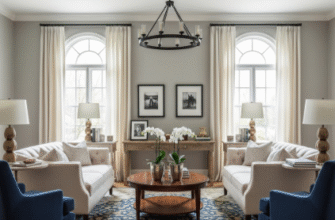
But here’s what I learned from a color consultant in Austin who stages luxury homes: neutral doesn’t mean beige anymore—it means “doesn’t trigger a visceral negative reaction in seventy percent of the population.” That burnt orange accent wall you love? Statistically, it’s going to make roughly half of potential buyers recoil, even if they can’t articulate why. Warm grays, soft whites, greige (yes, that’s a real word now and I hate it too)—these shades recieve the widest approval because they’re essentially visual silence. They let buyers project their own color fantasies onto the space without having to mentally erase your choices first, which is cognitive work most people don’t want to do when they’re already stressed about mortgages.
I watched a stager in Denver repaint a living room from deep teal to a color called “Accessible Beige” and the showing traffic doubled. Same house. Same light. Just less color for buyers to argue with in their heads.
Lighting Is Doing More Psychological Heavy Lifting Than You Realize and It’s Kind of Unsettling
Natural light is the holy grail, obviously, but most living rooms don’t have floor-to-ceiling windows facing south.
So you fake it. I spent an afternoon with a lighting designer who stages homes in Nashville, and she showed me this trick that felt almost manipulative: layer three types of light—ambient (overhead or recessed), task (table lamps at reading height), and accent (something aimed at art or architecture)—and the room suddenly feels professionally designed even if the furniture is from IKEA. The human eye craves variation in light levels because that’s how outdoor spaces work, with sun and shadow and dappled complexity, and when you replicate that indoors our brains relax because the lighting feels “natural” even though it’s entirely artificial. She also told me that rooms with only overhead lighting make people unconsciously anxious, which explained why I always felt vaguely tense in my last apartment.
And please, for the love of all that’s profitable, replace any bulb that’s not at least 2700K warm white. Cool-toned lighting makes skin look corpse-like and buyers will leave faster than you can say “great bones.”
The Accessories That Make Buyers Feel Something Instead of Just Seeing Something Empty
This is where staging gets weird and personal and a little bit like set design for a play nobody’s watching yet.
I used to think decorative objects were just filler—stuff to keep surfaces from looking sad—but a stager in Charleston explained that every object is a tiny story prompt. A cashmere throw draped (not folded) over the sofa suggests cozy Sunday mornings. A wooden tray with a candle and two coffee mugs implies leisurely conversations. Fresh flowers—real ones, not plastic, because buyers can tell and they judge you for it—signal care and upkeep. These aren’t logical signals; they’re emotional breadcrumbs that lead buyers toward a feeling of “I could be happy here,” which is the only feeling that actually closes sales. She told me that in her fifteen years of staging, the homes that sold fastest weren’t the biggest or the most updated—they were the ones where buyers walked in and exhaled, like they’d been holding their breath without knowing it.
Anyway, I guess the point is that staging isn’t about perfection. It’s about creating a version of home that’s just ambiguous enough for someone else to finish the story.