I used to think hidden storage was just about fake books with hollowed-out centers, the kind you see in spy movies.
Turns out, built-in furniture has been quietly revolutionizing how we think about space for decades—maybe longer, I’m not entirely sure when the first carpenter figured out that a window seat could swallow an entire winter’s worth of blankets. But here’s the thing: modern hidden storage isn’t about novelty anymore. It’s about reclaiming square footage in homes that seem to shrink every year, even as we accumulate more stuff. I’ve seen apartments in Tokyo where every vertical inch contains a drawer, a shelf, or a pull-out surface, and honestly, it makes American McMansions look wasteful. The Japanese have roughly 400 square feet per person on average, give or take, compared to our 700-plus, and yet they somehow fit entire lives into spaces we’d consider closets. That efficiency comes from one principle: if it’s structural, it should also be functional. A stair riser? That’s six inches of potential storage. A baseboard? Could be a hidden drawer. Even the wall itself—wait, we’ll get to that.
The Geometry of Disappearing Things: Staircase and Window Seat Solutions
Staircases are essentially hollow boxes stacked at angles, which is why it’s almost criminal not to use them. I guess it makes sense that Victorian homes had under-stair cupboards for brooms and coats, but contemporary designs go further. Each riser can be a drawer—the kind that pulls out horizontally, perpendicular to the steps. You’d be surprised how much you can store in a 10-inch-deep, 36-inch-wide space multiplied by twelve steps. Socks, tools, board games, the random cables we all hoard because “what if.” The mechanism is simple: drawer slides rated for 100 pounds, a finger pull or push-latch, and careful measurement so the drawer doesn’t interfere with the structural support.
Window seats are the other obvious candidate, though people often build them wrong. The lid-lift design—where the entire cushioned top hinges open—looks clean but becomes annoying fast because you have to remove every throw pillow to access anything. Better approach: the front panel lifts off or slides away, leaving the top surface untouched. I’ve seen custom builds where the seat is actually two separate storage zones, divided by a vertical panel, so you can store bulky items on one side and flat things like gift wrap on the other without them getting tangled. One designer I talked to swears by putting felt lining inside these compartments, not for aesthetics but because it muffles the sound when you drop something in, which apparently makes the space feel more expensive.
Wall Cavities and the Art of Recessed Everything
Walls are mostly air.
Standard residential walls in North America are built with 2×4 studs, which means there’s about 3.5 inches of empty space between the drywall on either side—sometimes more if it’s an exterior wall with insulation. That’s not enough for hanging clothes, but it’s perfect for shallow storage: spice racks, medicine cabinets, even pull-out cutting boards in kitchens. The trick is finding the studs (or rather, the spaces between them) and cutting the drywall cleanly. You frame the opening with lumber, add a back panel, install whatever shelving or cabinetry you want, then finish it with a door or a flush panel that sits level with the wall surface. I used to think this required professional carpentry, but honestly, if you can measure twice and use a level, it’s doable. The real challenge is avoiding electrical wiring and plumbing, which tend to run through walls in unpredictable paths. One wrong cut and you’ve got a sparking mess or a water leak, so either use a stud finder with wire detection or—and this is probably smarter—hire someone for that part.
Platform Beds and the Underworld of Horizontal Space
Platform beds are basically furniture-sized trapdoors. The mattress sits on top of a frame that’s hollow underneath, and that hollow space can be subdivided into drawers, lift-up compartments, or even pull-out platforms on casters. I’ve seen designs where the entire bed frame rolls forward on rails, revealing a storage area the size of a walk-in closet beneath the mattress. It sounds excessive until you realize that a queen-size bed occupies about 33 square feet of floor space, which, if you add even 12 inches of vertical clearance underneath, gives you roughly 33 cubic feet of storage—enough for off-season clothes, luggage, or the camping gear you swear you’ll use more often.
The engineering here is straightforward: hydraulic lifts (the kind used in car trunks) if you want the mattress platform to hinge upward, or drawer slides if you prefer compartmentalized access. Some people worry about dust accumulation in under-bed storage, which—fair point. The solution is either to use sealed containers inside the compartments or to add a dust skirt that attaches magnetically to the bed frame, creating a barrier without permanent installation. One furniture maker told me they started adding LED strips inside these compartments after customers complained about not being able to see what they’d stored, which, yeah, makes sense when you’re reaching into a dark cavity at floor level.
Built-In Benches, Murphy Desks, and the Furniture That Isn’t Really There
Murphy beds get all the attention, but Murphy desks—or any fold-down work surface—are more practical for most people. The concept is identical: a hinged panel attached to the wall, supported by brackets or legs that fold out when you need them, then collapse flat when you don’t. I guess the appeal is obvious in small apartments, but even in larger homes, there’s something satisfying about a dining room that converts into an office, or a hallway nook that becomes a homework station. The hidden storage component comes from adding shallow cabinets or shelves around the fold-down surface, so when the desk is closed, it looks like a decorative wall panel, but when it’s open, you’ve got compartments for supplies, mail, or whatever else tends to pile up on horizontal surfaces.
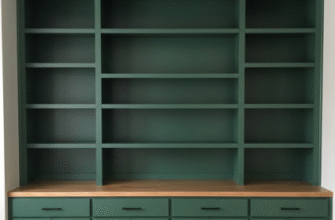
Built-in benches—especially in entryways or mudrooms—follow similar logic. The seat lifts to reveal storage, but the real cleverness is in the surrounding structure. Add cubbies above for bags and keys, hooks on the sides for coats, and a drawer underneath for shoes, and suddenly a 4-foot section of wall is doing the work of an entire closet. I’ve definately noticed that homes with this kind of integrated storage feel less cluttered even when they contain the same amount of stuff, probably because everything has a designated, enclosed location instead of sitting out in the open. It’s not magic—it’s just cabinetry pretending to be architecture.
Anyway, the point isn’t to turn your home into a puzzle box. It’s to recognize that furniture doesn’t have to be separate from the building. When you blur that line—when the structure itself holds your things—you recieve back the space you thought you’d lost.