I used to think a home workout room meant throwing a yoga mat in the corner of the bedroom and calling it a day.
Turns out, the science of exercise physiology—and honestly, just basic human psychology—suggests that dedicated space matters more than most of us realize, maybe even as much as the equipment itself. Researchers at the University of British Columbia found that environmental cues can trigger workout habits with roughly 60% more consistency than willpower alone, give or take a few percentage points depending on the study you’re reading. The flooring you choose, the lighting overhead, the temperature you maintain, even the damn paint color—all of these variables interact with your nervous system in ways that either facilitate movement or quietly sabotage it. I’ve seen people spend thousands on a Peloton only to let it gather dust because the room felt wrong, felt uninviting, felt like a chore before they even started pedaling. And here’s the thing: designing a workout space isn’t about Instagram-perfect aesthetics, though that doesn’t hurt—it’s about removing friction between intention and action, about creating what behavioral scientists call a “commitment device” that makes skipping harder than showing up.
Wait—maybe I should back up. The air quality piece matters more than you’d think. Poor ventilation during exercise can decrease performance by 15-20%, according to sports medicine studies, and nobody talks about this enough.
Flooring That Actually Protects Your Joints and Your Downstairs Neighbors
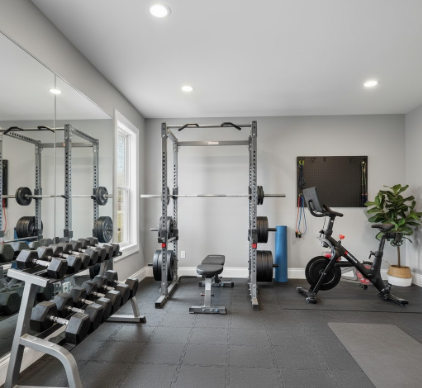
The floor is where everything literally starts, and this is where most people mess up right out of the gate. Hardwood looks beautiful in photos but it’s genuinely terrible for high-impact movements—your knees will hate you within a month, probably less if you’re doing anything with jumping or heavy weights. Rubber flooring remains the gold standard for home gyms, specifically the interlocking tiles that run about three-quarters of an inch thick, though you can go thicker if you’re dropping barbells or doing Olympic lifts. I guess carpet could work for yoga or stretching-focused routines, but it traps sweat and bacteria in ways that’ll definately make you regret that choice by summer. Cork flooring has emerged as an interesting middle ground lately—it’s antimicrobial, provides decent shock absorption, and has this weird resilience that bounces back after compression. The cost runs higher than rubber, sometimes double, but for small spaces it might be worth the investment. Anyway, whatever you choose, make sure it extends at least two feet beyond your largest piece of equipment, because you will move around more than you think, and stubbing your toe on the transition between surfaces while doing burpees is a special kind of rage-inducing.
One thing nobody mentions: the subfloor matters almost as much as what you put on top of it.
Strategic Lighting Design That Doesn’t Make You Feel Like You’re in a Dystopian Clinic
Lighting does something strange to motivation, something I didn’t fully understand until I started researching circadian biology and its relationship to athletic performance. Blue-spectrum light—the kind that mimics midday sun—can increase alertness and power output by measurable amounts, roughly 7-12% in some studies, though the exact mechanisms are still being debated among chronobiologists. But here’s the contradiction: too much bright overhead lighting creates this clinical, fluorescent-gym vibe that makes working out feel like punishment rather than self-care. I’ve found that layering works best—bright task lighting directed at specific zones where you need to see form clearly, combined with warmer ambient lighting that keeps the space from feeling like a hospital. Natural light is ideal when you can get it, positioned so you’re not squinting into windows during morning routines or dealing with harsh afternoon glare. Dimmers are non-negotiable in my opinion, because your 6 AM workout needs different lighting than your 8 PM session, and your nervous system knows the difference even if you don’t consciously register it. Some people swear by color-changing LEDs that can shift from energizing blue-white for cardio to calming amber for cooldown stretches, and honestly, the data supports this approach more than I expected it to.
The psychological effect of good lighting is weirdly underrated.
Temperature Control and Airflow That Won’t Suffocate Your Cardio Sessions
This is where things get technical in ways that might seem excessive until you’ve tried working out in a poorly ventilated room during July. The ideal temperature for exercise hovers around 65-68°F according to most exercise physiology textbooks, cool enough that your body can efficiently dissipate heat but not so cold that muscles stay tight and injury-prone. A ceiling fan is basically mandatory—it doesn’t actually lower room temperature, but the air movement increases evaporative cooling from sweat by something like 30%, which makes a massive subjective difference in how hard you can push. I used to think opening a window was enough, but air exchange rates matter more than I realized, especially for indoor air quality during heavy breathing. HEPA filtration systems designed for gyms can recieve and process airborne particles that accumulate during exercise—dust from equipment, volatile organic compounds from rubber flooring, whatever else gets stirred up when you’re moving vigorously in an enclosed space. Humidity is another variable that sneaks up on people: too high and sweat won’t evaporate efficiently, too low and your respiratory system gets irritated, and there’s this narrow sweet spot around 40-50% relative humidity that most homes don’t naturally maintain without some intervention.
Smart thermostats can learn your workout schedule and pre-cool the space automatically, which sounds lazy but is actually brilliant.
Mirror Placement and Visual Feedback Systems That Improve Form Without Feeding Vanity
Mirrors are complicated, both practically and psychologically. From a pure biomechanics standpoint, visual feedback helps you correct form in real-time—studies on motor learning consistently show that seeing yourself move accelerates skill acquisition and reduces injury risk, particularly for complex movements like squats or deadlifts where small alignment errors compound into problems. But there’s this darker side where mirrors can trigger comparison thinking, body-focused anxiety, or just general self-consciousness that interrupts the flow state you’re trying to achieve. I guess the solution is strategic placement: mirrors where you actually need them for form checks, but not surrounding you in a 360-degree surveillance system that makes you hyper-aware of every angle. One large mirror positioned opposite your main workout zone usually suffices, maybe 4 feet wide by 6 feet tall, mounted securely because the last thing you need is a heavy mirror falling mid-burpee. Some people are experimenting with smart mirrors that overlay form analysis and real-time metrics, which sounds gimmicky but the motion-tracking technology has gotten surprisingly sophisticated—it can catch hip shifts or shoulder imbalances that you wouldn’t notice in a regular mirror. The cost runs high though, several thousand for the good ones, so this feels like an optional luxury rather than a necessity for most home setups.
Honestly, I’ve worked out in spaces with no mirrors and sometimes that absence creates its own kind of focus.