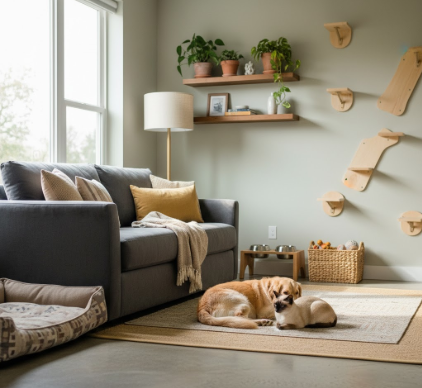
I used to think you had to choose between a home that looked like a West Elm catalog and one that didn’t smell like a kennel.
Turns out, that’s a false binary—and honestly, it took me way too long to figure that out. My friend Sarah has this gorgeous mid-century modern place in Portland, all clean lines and fiddle-leaf figs, and she’s got two massive rescue dogs who basically run the operation. The first time I visited, I kept waiting for the other shoe to drop: the chewed-up furniture, the fur tumbleweeds, the inevitable compromise. But here’s the thing—her place was immaculate. Not in that sterile, no-one-lives-here way, but in a way that felt intentional, lived-in, and decidedly stylish. She’d cracked some kind of code I hadn’t even known existed, and I needed to understand it.
So I started asking around. Interior designers who owned cats. Architects with elderly labs. People who’d somehow managed to integrate their animals into their aesthetic rather than apologizing for them.
The Fabric Conspiracy: Why Your Couch Is Probably Lying to You
Wait—maybe I should back up.
The biggest mistake people make is thinking “pet-friendly” means “ugly.” That’s what the big-box stores want you to believe, anyway, because then you’ll buy their industrial-grade microfiber sectionals in shades of Sad Beige. But performance fabrics have gotten weirdly sophisticated in the past five years or so. I’m talking about materials that feel like linen or velvet but repel liquids like they’re coated in some kind of invisible forcefield—because, well, they kind of are. Crypton and Sunbrella have been doing this for a while, but newer companies like Revolution and Perrennials are making textiles that you’d never clock as “technical” unless someone told you. My colleague bought a cream-colored (yes, cream) Revolution sofa three years ago, and her cat has definitley tried to destroy it approximately ten thousand times. The thing still looks new.
The science here is pretty straightforward, if a bit unglamorous: these fabrics use fluoropolymer treatments or tightly woven synthetic fibers that create a barrier at the molecular level. Stains literally can’t penetrate because there’s nowhere for them to go. It’s the same principle that makes Gore-Tex work, just applied to your living room instead of your hiking jacket.
Here’s what I wish I’d known earlier: you don’t have to sacrifice texture or color. You just have to ask better questions when you’re shopping. “Is this machine-washable?” “What’s the double-rub count?” (Anything above 30,000 is considered heavy-duty; for context, your average retail fabric clocks in around 15,000, give or take.) I’ve seen people build entire rooms around these materials and you’d never know they were engineered to withstand chaos.
Strategic Architecture, or How to Make Your Dog Think It Was Their Idea All Along
Anyway, the fabric thing is only half the battle.
The other half is spatial design—which sounds pretentious, but really just means thinking about how your pet moves through space and then designing around that instead of against it. My sister’s dog used to destroy the corner of her hallway because he’d take it too fast coming down the stairs, skid out, and slam into the drywall like a furry missile. She tried everything: baby gates, training, threats. Nothing worked until she put a narrow console table in that exact spot. Suddenly the dog had a visual cue to slow down, and the table became this beautiful landing zone for keys and mail. Problem solved, and her house looked better for it.
This is where people get tripped up—they try to pet-proof by removing things, when sometimes you actually need to add them. Strategically placed rugs can protect hardwood and give dogs better traction. Built-in window seats give cats vertical territory so they’re not climbing your curtains. A recessed feeding station keeps bowls out of walkways and makes the whole thing feel designed rather than tacked-on. I guess it’s about working with animal behavior instead of pretending it doesn’t exist.
One designer I talked to—she works mostly on high-end residential projects in Austin—told me she now includes “pet circulation patterns” in her initial assessments, right alongside human traffic flow and sight lines. She maps where the cat likes to sunbathe, where the dog sleeps, which windows they stare out of. Then she builds the design around those anchor points. It sounds almost absurdly thorough, but the results are spaces that feel cohesive rather than compromised.
The thing no one tells you is that pet-friendly design is actually just good design, period. Durable materials, thoughtful layouts, surfaces that are easy to clean—these aren’t concessions. They’re practical choices that make a home more livable for everyone, whether you’ve got pets or kids or just a tendency to spill coffee. I used to think accommodating animals meant lowering your standards, but honestly, it’s the opposite.
It’s raising them.