I used to think laundry rooms were just—well, rooms where you did laundry.
Then I moved into a place with a laundry “closet” that was basically a stacked washer-dryer shoved into a corner next to the kitchen, and I realized how much design actually matters when you’re standing there at 11 PM trying to figure out where to put a basket of wet towels while also needing somewhere to fold them and also—wait, where did I put the detergent? Turns out, a functional laundry space isn’t just about having the machines; it’s about creating a system that doesn’t make you want to give up on clean clothes entirely. The best laundry rooms I’ve seen, the ones that actually work for real humans doing real laundry, combine smart storage with enough counter space to actually use, plus lighting that doesn’t make you feel like you’re in a basement even if you literally are in a basement. And here’s the thing: you don’t need a massive budget or a dedicated room the size of a bedroom to make it happen.
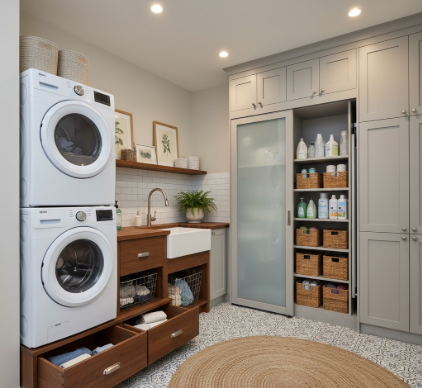
What I didn’t expect was how much vertical space matters. Most people focus on floor space, which makes sense—that’s where the machines go. But if you look at how professional organizers approach laundry rooms, they’re obsessed with walls. Shelving above the washer and dryer can hold detergent, fabric softener, stain removers, all those random supplies that otherwise end up scattered on top of the machines or, worse, on the floor. I guess the ideal height is somewhere around 18 to 24 inches above the machines, give or take, depending on your ceiling height and whether you can actually reach that high without a step stool.
The Counter Space Dilemma and Why Everyone Gets It Wrong Initially
Here’s what nobody tells you: you need more counter space than you think.
I’ve talked to interior designers who specialize in laundry rooms—yes, that’s a thing—and they say the single most common mistake is underestimating how much horizontal surface area you actually need for folding, sorting, and just setting things down while you work. The minimum functional counter depth is around 24 inches, though 30 inches is better if you have the space, and you want at least 36 inches of width, ideally more like 48 to 60 inches if you’re folding anything larger than hand towels. Some people install a countertop over front-loading machines, which works great if your machines are the same height and you don’t mind the permanence of it. Others prefer a separate folding table or a wall-mounted fold-down counter, which gives you flexibility but requires more wall space. Honestly, I’ve seen both approaches work, and I’ve seen both approaches fail, usually because people didn’t think through their actual laundry workflow before committing to a design.
The other thing about counters: material matters more than you’d think. Laminate is cheap and fine for most people, but it can warp if you set a hot dryer vent on it or if water sits on it too long. Butcher block looks beautiful but needs regular sealing. Quartz is basically indestructible but costs roughly three times what laminate does, maybe more depending on where you live.
Lighting That Doesn’t Make You Want to Cry When Checking for Stains
I used to think any light was fine as long as you could see.
Then I tried to check whether a stain had actually come out under a dim yellow bulb, and I realized that laundry room lighting is actually kind of critical if you care about whether your clothes are actually clean. The consensus among lighting designers—and yes, I went down that rabbit hole—is that you want bright, neutral-white LED lighting in the 4000K to 5000K range, which is cooler than the warm 2700K you’d use in a living room but not as harsh as the 6500K you’d find in a hospital. Task lighting under cabinets or above the counter helps with detail work like pre-treating stains or sewing on a button. Overhead lighting should be bright enough that you’re not squinting, ideally around 75 to 100 lumens per square foot, though I’ll admit I’m not great at calculating that on the fly and usually just buy bulbs labeled “bright white” and hope for the best.
Some people install dimmer switches, which seems like overkill until you’re doing laundry late at night and don’t want to be blasted with institutional-level brightness. I guess it’s one of those things that feels silly until you have it, and then you can’t imagine going back.
Storage Solutions That Actually Hold Things Without Looking Like a Janitor’s Closet From a 1980s Office Building
The storage part is where design meets function, and where a lot of laundry rooms either shine or turn into chaotic messes that make you avoid doing laundry altogether.
Closed cabinets hide clutter, which is great if you’re the kind of person who accumulates half-used bottles of specialized detergents for specific fabrics, but they also make it harder to see what you have, which means you might buy duplicates or forget you already have stain remover until you find three bottles six months later. Open shelving looks cleaner and more modern—assuming you keep it organized—but it also means everything is on display, so you either need to commit to attractive storage containers or accept that people will see your jumbo box of Tide pods. Pegboards are having a moment, partly because they’re customizable and partly because they look kind of cool in a minimalist-industrial way, and you can hang things like spray bottles, brushes, and lint rollers on hooks that you can rearrange whenever you want.
I’ve seen people install pull-out hampers in lower cabinets, which is genius if you have the cabinet space and the budget for the hardware. Others use rolling carts, which are cheaper and more flexible but also more likely to end up shoved in a corner and forgotten. Wire baskets work well for storing things like rags or cleaning cloths that don’t need to look perfect. The key, I think, is figuring out what you actually use regularly versus what you think you should have in a laundry room—because there’s a big difference between a well-designed space and a space that’s designed to look good in a magazine but doesn’t actually match how you do laundry.
Anyway, that’s most of it. The rest is just making sure your machines are level, your vents are clean, and you’ve got a place to hang things that can’t go in the dryer—which, if you’re like me, is more things than you’d like to admit.