
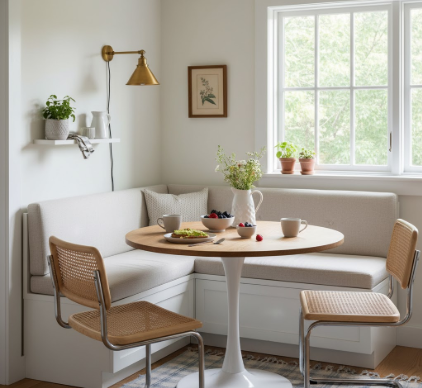
I spent three years in a galley kitchen so narrow that opening the dishwasher meant blocking the entire walkway, and I still managed to carve out a breakfast nook that felt—well, not spacious, but at least intentional.
The thing about breakfast nooks is that we’ve been conditioned by HGTV and Pinterest to think they require a sunny bay window, built-in bench seating with storage underneath, and roughly four to six feet of dedicated floor space. But here’s the thing: the earliest breakfast nooks, which emerged in American homes during the 1920s as part of the Craftsman movement, were actually designed as space-saving solutions for modest bungalows where formal dining rooms were considered wasteful. They were utilitarian first, charming second. Somehow we’ve reversed that priority entirely, and now people with 200-square-foot kitchens think they can’t have one at all because they don’t have a windowed alcove or room for a pedestal table. I used to think the same way—that a breakfast nook was a luxury feature, something you graduated to after you’d already secured adequate counter space and a full-size refrigerator. Turns out, it’s more about stealing inches than claiming feet, and the psychology of creating a defined eating zone matters more than the square footage you dedicate to it.
Wait—maybe I should back up. When I say “limited kitchen space,” I mean truly limited: think 70 to 120 square feet, which is typical for older apartment buildings, starter condos, and a shocking number of urban rentals. In spaces like these, you’re not designing a breakfast nook so much as negotiating with physics and stubbornness.
The Corner Gambit: Making Dead Zones Earn Their Keep
Corners are where kitchens go to die, functionally speaking. You’ve got that awkward triangle of floor space where two walls meet, often colonized by a trash can or a dying plant or, in my case for years, a slowly accumulating pile of reusable grocery bags. But corners are also—and I mean this with the kind of certainty that comes from measuring dozens of them—the single best place to wedge in a breakfast nook without sacrificing workflow. The average corner can accomodate a small round table (30 inches diameter) or a corner banquette setup that seats two to three people comfortably, assuming you define “comfortably” the way New Yorkers do, which is to say with some generosity toward the concept of personal space. I’ve seen corner nooks work in kitchens where the total clearance between the table edge and the opposite counter was just 32 inches—technically below the 36-inch minimum that kitchen designers recommend for walkways, but workable if you’re not trying to pass someone while carrying a sheet pan. Honestly, most of us aren’t.
The trick is going vertical with storage. Wall-mounted drop-leaf tables (the kind that fold down when not in use) have been around since the 18th century, but they’ve had a quiet renaissance in the last decade as urban density has pushed designers toward collapsible solutions. You can mount one in a corner, pair it with a narrow bench or even a couple of wall-mounted folding chairs, and reclaim the space entirely when you’re cooking. IKEA’s NORBERG table, for instance, is 74 cm wide and costs around $50, which feels almost offensively practical. I guess it makes sense that Scandinavian design, which evolved in countries where winter darkness and small living spaces are existential facts, would nail this particular problem.
The other option is a corner banquette, which sounds elaborate but can be as simple as a low platform with a cushion and a small triangular or round table pushed into the corner. You lose some flexibility—banquettes don’t move easily—but you gain storage underneath and a surprising amount of seating density. Two people can sit comfortably; three can squeeze in for breakfast if nobody’s wearing a puffy coat. The platform itself can be a simple plywood box (18 inches high is standard seating height) or, if you’re renting and can’t build anything permanent, a couple of kitchen storage cubes pushed together and topped with a foam cushion. It’s not going to win design awards, but it definately works.
The Ledge Philosophy: When You Can’t Claim Floor Space, Claim Wall Space Instead
Sometimes there’s no corner. Sometimes the kitchen is a straight galley or an L-shape where every inch of floor space is already spoken for by the need to, you know, walk. In those cases, you’re looking at a wall-mounted solution—a narrow ledge or bar that functions as a perch rather than a proper table. I used to think these felt too much like eating at an airport standing table, but after installing a 10-inch-deep shelf at counter height (36 inches) along one wall of my old kitchen, I found it became the place I actually wanted to eat breakfast. There’s something about facing the wall, oddly enough, that makes the meal feel more contained and less like you’re eating in a hallway.
The depth matters here. Anything less than 9 inches feels precarious—you’re constantly worried about knocking your coffee mug onto the floor. But 10 to 12 inches gives you enough room for a plate, a mug, and maybe a phone or a book propped against the wall. You’ll need stools, obviously, and this is where you run into the clearance problem again: a standard stool with a footrest requires about 24 inches of floor space when someone’s sitting on it. In a galley kitchen, that might mean you can only pull out one stool at a time, or you have to tuck them under the ledge when not in use, which—wait—maybe that’s fine? I think we’ve been conditioned to think every solution needs to be permanent and always-accessible, but some of the best small-space designs are the ones that require a tiny bit of effort to deploy and stow.
I’ve seen people mount a ledge above a radiator (heat rises, so it’s actually weirdly cozy in winter) or along a half-wall that divides the kitchen from the living room, which has the bonus of making the breakfast nook feel like a threshold space rather than a kitchen appendage. It’s scrappy. It’s imperfect. But it works, and sometimes that’s the whole point.
The materials can be as simple as a solid wood shelf from a home improvement store (pine runs about $20 for a 6-foot length) mounted on heavy-duty brackets, or as considered as a custom piece of butcher block that matches your countertops. Either way, the logic is the same: you’re borrowing vertical real estate because the horizontal stuff is already spoken for.
Anyway, none of this is revolutionary. People have been eating in small kitchens for as long as kitchens have existed, and the idea that you need a formal dining room or even a dedicated nook is a relatively recent and, frankly, culturally specific invention. But I do think there’s something valuable about naming the goal—about saying, yes, I want a place to sit and eat breakfast in my kitchen, even if that place is a 10-inch ledge or a corner banquette made from storage cubes. It changes how you see the space, and that shift in perception is worth roughly as much as the square footage itself.








