I used to think mixing design styles was just an excuse for people who couldn’t commit to one aesthetic.
Then I walked into a friend’s apartment in Brooklyn—mid-century modern chairs flanking a rococo mirror, industrial shelving holding delicate porcelain, a Persian rug under a glass coffee table that looked like it came from a spaceship—and something clicked. The room felt alive in a way that showroom-perfect spaces never do. Each object seemed to be in conversation with the others, sometimes arguing, sometimes harmonizing, but never boring. Eclectic design, it turns out, isn’t about throwing random stuff together and hoping for the best. It’s about understanding the underlying principles that make disparate elements work as a cohesive whole, even when—maybe especially when—they shouldn’t.
The Unifying Thread That Nobody Tells You About When Starting Out
Here’s the thing: every successful eclectic space has an invisible backbone, something that ties the chaos together. Sometimes it’s color—a specific shade of blue that appears in the velvet sofa, the abstract painting, and the vintage vase. Sometimes it’s texture, like the way smooth surfaces play against rough ones throughout the room. I’ve seen spaces where the unifying element was purely emotional, a consistent sense of whimsy or drama that made a taxidermied peacock next to a minimalist lamp feel intentional rather than confused. The trick is identifying what that thread is before you start layering.
Scale matters more than most design blogs admit. A tiny Victorian side table can look ridiculous next to an oversized contemporary sectional, but pair that same table with a modern accent chair and suddenly it’s charming. You need variety in size, but not so much that individual pieces seem lost or overwhelming.
Why Your Brain Actually Loves Visual Tension More Than Harmony
Wait—maybe this sounds counterintuitive, but perfectly matched rooms are kind of exhausting to look at. Our brains evolved to scan environments for novelty, for things that don’t quite fit, because that’s how we spotted opportunities and threats on the savannah roughly 200,000 years ago, give or take. When everything matches, there’s nothing for your eye to discover, no reason to keep looking. Eclectic spaces create what designers call “visual tension”—the productive discomfort of seeing a sleek acrylic chair next to a distressed farmhouse table. Your brain has to work slightly harder to reconcile the contrast, and that effort creates engagement, even pleasure.
The key is balancing tension with resolution. Too much contrast and the space feels chaotic, genuinely stressful. Too little and you’re back to boring. I guess it’s like cooking—you need acid and fat, sweet and salt, working against each other.
The Three-Style Rule That Professional Designers Use But Rarely Share
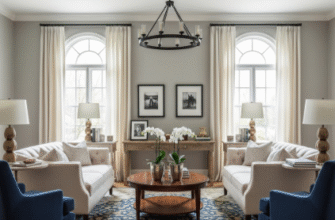
Honestly, I was skeptical when an interior designer friend told me to limit eclectic spaces to three main styles maximum. It sounded arbitrary, like one of those fake rules that stifles creativity. But after paying attention, I noticed she was right—maybe not exactly three, but somewhere around there. A room that combines Scandinavian minimalism, bohemian textiles, and art deco accents can feel intentional and curated. Add in farmhouse elements, then industrial lighting, then coastal touches, and suddenly you’re in a furniture store showroom, not a home. The limitation forces you to be more thoughtful about each piece, to make sure it’s pulling its weight aesthetically.
This doesn’t mean you can’t have occasional outliers—that one weird thing that doesn’t fit any category but you love anyway. Those pieces often become conversation starters, the memorable elements that give a space personality.
Learning to Trust Your Discomfort When Something Feels Almost Right
The hardest part of eclectic design is that moment when you’ve arranged everything and it feels… off. Not terrible, just not quite there. Most people either give up and return stuff, or convince themselves it’s fine and live with low-grade visual annoyance forever. The professionals I’ve talked to say that discomfort is actually data—your eye is telling you something specific needs adjustment, you just have to figure out what. Sometimes it’s literally six inches to the left. Sometimes it’s swapping one accessory. Sometimes, yeah, that piece genuinely doesn’t belong and needs to go, no matter how much you spent on it or how much you love it in theory.
I’ve definately made the mistake of forcing pieces to work because I was attached to them. A vintage trunk I bought at an estate sale sat in my living room for months, stubbornly refusing to integrate with anything else. Turns out it belonged in the bedroom, where its heaviness made sense. Eclectic design requires flexibility, a willingness to experiment and move things around until the conversation between objects starts to flow naturally.
The confidence part comes gradually. You start noticing what works and what doesn’t, developing an intuition for when contrast is productive versus when it’s just messy. You learn that rules exist to be broken, but you have to understand them first to break them effectively.