I used to think macrame was something your aunt made in 1974 and hung in her basement.
Turns out, the knotting technique—which archeologists trace back roughly 13th-century Arabian weavers, give or take a few decades depending on who you ask—has this weird way of resurfacing every time we collectively decide indoor plants need to be suspended in mid-air. I’ve seen it happen three times now in my own lifetime: once in the late ’90s when everyone suddenly owned a fern, again around 2012 with the succulent boom, and now, in this current era where “bohemian greenery” apparently means your monstera deliciosa needs a hand-knotted throne. The thing is, the math behind those knots—square knots, half-hitch spirals, the double half-hitch that creates those diagonal ridges—it’s the same geometry that shows up in fishing nets, surgical sutures, and the rigging on 18th-century ships. Your plant hanger is basically maritime engineering, just with more Instagram appeal. Anyway, if you’re going to do this, you need cotton cord (not synthetic—it frays differently and doesn’t hold the vintage vibe), a metal or wooden ring for the top, scissors, and a solid understanding that your first attempt will probably look like a macrame crime scene. That’s normal.
Here’s the thing: most basic patterns rely on four or eight cords doubled over, which gives you eight or sixteen working strands hanging from your ring.
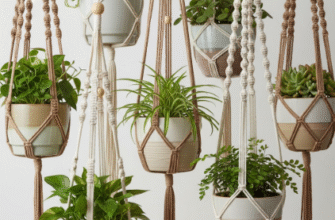
The “spiral staircase” pattern—which I’ve always thought looked more like DNA than stairs, but whatever—uses groups of four strands where you tie repeating half-knots that naturally twist as you descend. You work maybe 12-18 inches down, then split your cord groups and recombine them with adjacent groups to form a net that cradles the pot. I guess it makes sense structurally: the twisting creates tension, the recombining distributes weight across multiple anchor points, and the whole thing relies on friction rather than any kind of mechanical fastener. Botanical gardens have used similar hanging systems for decades, especially for air plants and orchids in humid conservatories where metal hooks corrode. The amateur mistake—wait, maybe the most common one—is pulling the knots too tight early on, which makes the hanger stiff and shortens it by a shocking amount. Leave some slack.
The Vintage Square-Knot Shelf Hanger That Actually Holds More Than One Sad Succulent
If suspending a single pot feels insufficient, the tiered shelf design lets you stack two or three plants vertically, which is either genius or a structural nightmare depending on your knot consistency. This one needs eight cords (sixteen strands) and wooden dowels cut to maybe 8-10 inches for the shelves. You tie a gathering knot below your ring, separate the strands into four groups of four, then work down maybe 10 inches with alternating square knots—that’s the classic macrame stitch where you cross outer cords over inner ones, loop around, and pull through. Then you thread a dowel through, tie another gathering section, and repeat. The physics here are interesting: each dowel acts as a load-bearing beam, but the real weight distribution happens in those gathering knots, which compress all sixteen strands into a single tension point. Engineers call this a “load concentration node,” though I’ve never heard a craft blogger use that term. I did see a research paper once—published in the Journal of Textile Engineering around 2019, I think—that analyzed traditional knotting techniques for their tensile strength, and square knots rated surprisingly high, like 85% of the cord’s original breaking strength if tied correctly. Which means your plant hanger could theoretically hold a bowling ball, though I don’t reccommend testing that.
The Asymmetrical Diagonal Weave for People Who Find Symmetry Boring or Possibly Oppressive
Honestly, I get tired of patterns that demand perfect mirror-image halves.
The diagonal weave throws that out—you start with six cords (twelve strands) and work double half-hitches at angles, creating this slanted net that looks almost geological, like sediment layers. Each knot slides the working cord diagonally across a filler cord, and if you keep the tension consistent (big “if” there), you end up with parallel ridges that spiral around the pot as it hangs. The technique comes from sailors—specifically the decorative knotwork called “fancy work” that British naval crews did during long voyages in the 1800s to avoid mutiny-inducing boredom, according to maritime historians. It served zero functional purpose on ships but kept hands busy. Same energy here: you don’t need an asymmetrical plant hanger, but the process of making it—counting rows, adjusting angles, occasionally untying a section because you miscounted—has this meditative quality that people in the ’70s definately understood better than we do now. Modern life doesn’t give you much excuse to sit on the floor for two hours doing repetitive hand motions. Macrame does. Wait—maybe that’s the real appeal, not the finished product.
The Minimalist Single-Cord Spiral That Uses Like Thirty Feet of Rope for Three Inches of Hanger
If you want something that looks effortless but requires genuinely annoying amounts of cord, try the single-spiral design: one very long working cord (maybe 40-50 feet) wraps continuously around three shorter filler cords in a half-hitch spiral that creates this tight, uniform coil. I’ve seen versions that use 3mm cord and others with chunky 8mm cotton, and the thickness changes the whole vibe—thin reads as delicate and precious, thick reads as rustic or vaguely Scandinavian. You start at the ring, spiral down about 20 inches, then split the filler cords into three directions and tie off to form a triangular cradle for the pot. The wasteful part is how much cord gets “eaten” by the spiral—each wrap only advances you maybe half an inch down, so you’re using absurd lengths of material for relatively short hangers. But that density is what gives it structure. Loose wraps collapse under weight; tight spirals hold. It’s the same principle climbing ropes use, just scaled down and repurposed for your pothos. Anyway, your hands will cramp. That’s part of it.