
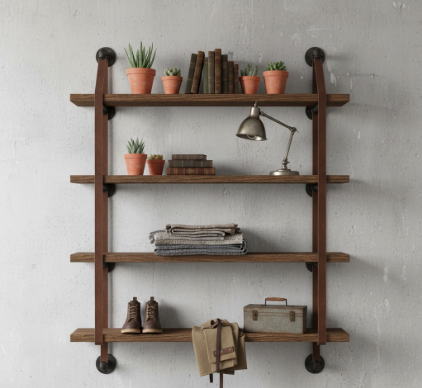
I used to think leather straps were just for belts and watch bands, but then I saw someone hang an entire bookshelf with them.
The thing about DIY leather strap shelving is that it looks deceptively simple—two leather straps, some screws, a wooden plank—but there’s this weird alchemy that happens when you get the proportions right. I’ve seen people use straps that are too thin, and the whole setup looks nervous, like it’s apologizing for existing. Then there are the ones who go too thick, and suddenly you’ve got something that belongs in a medieval dungeon rather than your living room. The sweet spot, turns out, is usually around 1.5 to 2 inches wide, though I guess it depends on how heavy your books are or whether you’re just displaying succulents and your collection of vintage cameras. Vegetable-tanned leather works best because it ages better than chrome-tanned stuff, developing this rich patina over time instead of just looking worn out. You can find it at craft stores or online for roughly $15 to $40 per strap depending on length and quality, give or take.
Anyway, the installation process is where most people either feel like geniuses or question all their life choices. You’ll need to locate your wall studs—seriously, don’t skip this step unless you want your shelf and everything on it crashing down at 3 a.m.—and mark where your screws will go. I measured wrong on my first attempt and ended up with one strap three inches higher than the other, which created this fun optical illusion that made visitors tilt their heads like confused dogs.
Why Industrial Style Actually Works With Leather (Even Though It Probably Shouldn’t)
Here’s the thing: industrial design is supposed to be all metal and concrete and exposed pipes, right? Cold materials, hard edges, that whole reclaimed-factory aesthetic. So leather straps seem like they shouldn’t fit, but they do—maybe because leather has its own history of workshops and craftspeople, or maybe because the contrast between soft organic material and rigid geometric shelving creates visual tension that our brains find satisfying. I used to overthink this, honestly. The science writer in me wanted to understand the neurology of why we find certain material combinations aesthetically pleasing, but then I realized I was spending more time researching visual perception studies than actually building shelves. The practical reality is that leather straps soften the industrial look just enough to make it feel intentional rather than like you’re living in an unfinished warehouse. You can pair them with reclaimed wood for warmth, or go full industrial with black iron pipes as shelf brackets—wait, actually, that defeats the purpose of the leather straps unless you’re using them decoratively on the sides.
The color matters more than you’d expect. Natural tan leather gives you that Scandinavian-modern vibe, while darker browns or blacks push further into industrial territory. Some people dye their straps, though I’ve seen that go wrong when the dye isn’t properly set and you end up with color transfer on your walls.
The Part Where You Actually Have to Do Math and Measure Things Correctly
Measuring is where my own projects usually fall apart, if I’m being honest. You need to account for the thickness of your shelf board plus how far down you want the straps to hang—and here’s where it gets fiddly—you also need to consider how the leather will stretch over time under weight. Leather isn’t static; it’s going to give a little, maybe a quarter inch or so depending on load and quality, which means your shelf might sag slightly after a few months. This isn’t necessarily bad; it adds to the lived-in character. But if you’re displaying something expensive or sentimental, you might want to pre-stretch your straps by hanging them with weight for a week before installation. I definately didn’t do this on my first project, and six months later one of my shelves had developed this slight tilt that made my partner nervous every time they walked past.
The actual assembly requires decent screws—I’d reccomend at least 3-inch wood screws if you’re going into studs, with washers to prevent the leather from tearing at the screw points. Some tutorials suggest riveting the strap loops, which looks cleaner but requires tools most people don’t have lying around. Honestly, a well-placed screw through doubled-over leather works fine for most applications, assuming you’re not storing your anvil collection up there. Weight capacity is tricky to estimate, but most setups can handle 20 to 40 pounds per shelf if properly secured to studs, though don’t quote me on that because I’m not a structural engineer and variables like leather quality and shelf span matter enormously.
The imperfections are what make it work, I guess—the slight variation in strap length, the way the leather creases differently on each side, the fact that nothing is ever perfectly level no matter how many times you check with your laser level. That’s the appeal of DIY industrial style: it’s supposed to look a little rough, a little unfinished, like you made it yourself because you did.








