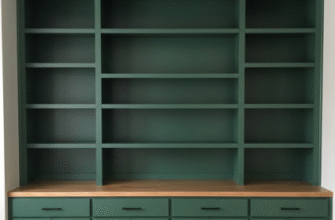
I used to think ladder shelves were just those flimsy things you’d see in a college dorm, leaning against a wall like they might give up any second.
Turns out, when you actually build one yourself—with real wood, not particleboard held together by hope and Allen keys—they become something else entirely. Something sturdy enough to hold your grandmother’s pottery collection, or a row of succulents that won’t immediately tumble to their doom. I built my first one in 2019, mostly because I was tired of horizontal surfaces eating up floor space in my apartment, and I needed somewhere to put books that wasn’t another bookcase blocking the window. The vertical logic made sense: five shelves stacked at angles, each one narrower than the one below, leaning at maybe 75 degrees against the wall. Gravity does most of the work. You’re essentially tricking physics into holding your stuff by distributing weight downward along two long rails that act as the ladder’s sides. The whole thing looks precarious but isn’t, assuming you don’t build it like an idiot.
Here’s the thing: most online tutorials will tell you to use 1×4 pine boards for the shelves and 1x3s for the side rails. That works fine if you’re displaying paperbacks. But if you want to put anything with actual weight—cast iron bookends, a vintage typewriter, a toddler who doesn’t understand boundaries—you need to go thicker. I’ve seen people use 1×6 boards for shelves, which gives you more depth, and 1x4s for the rails, which adds lateral strength. The math gets weird because you’re cutting the shelf supports at angles, usually around 15 degrees, so the shelves sit level even though the whole frame is tilted. You’ll need a miter saw for this, or at least a circular saw and a willingness to measure twice and curse once.
The Geometry of Leaning Things Against Walls Without Regret
The trickiest part isn’t the cutting—it’s figuring out shelf spacing before you commit to drilling pilot holes.
Most designs space shelves 12 to 16 inches apart vertically, but that’s measured along the angled rails, not straight up and down. If you space them 12 inches along a rail tilted at 75 degrees, the actual vertical distance between shelves is only about 11.6 inches, give or take your high school trigonometry skills. I always sketch this out on graph paper first, marking where each shelf will sit relative to the floor, because once you screw supports into those rails, you’re stuck with it. Unless you want to fill holes with wood putty and pretend you meant to do that. The width of each shelf should decrease as you go up—maybe 36 inches at the bottom, 30 at the next level, then 24, 18, and 12 at the top. This creates the tapered look and keeps the center of gravity low, which is the only reason this design doesn’t just tip forward and ruin your day.
You’ll also need to decide whether to use pocket screws or dowels to attach the shelves to the side rails. Pocket screws are faster and stronger, but you’ll see the holes unless you plug them, which adds time. Dowels look cleaner but require more precision—drill the holes even slightly off-center and the shelf sits crooked, which you won’t notice until you’ve glued everything and it’s too late to fix without a sawzall and a bad attitude.
Finishes That Won’t Make You Look Like You Tried Too Hard
I guess the finish is where people either commit to the aesthetic or panic and slap on whatever’s in the garage.
If you’re using pine, which is soft and shows every ding, a clear polyurethane coat works if you like that natural blonde wood look. But pine also takes stain unevenly—it blotches like a sunburn—so you’ll want to use a wood conditioner first, let it dry for maybe 15 minutes, then apply the stain in thin coats. I’ve used Minwax Provincial on pine ladder shelves before, and it comes out looking almost like oak if you’re patient. Or you could paint the whole thing, which hides sins and lets you match your wall color. Some people do a two-tone thing: dark rails, white shelves. It’s very 2018 farmhouse chic, but honestly, it still looks good if you don’t overdo the distressing. No one needs fake wormholes. The wood is already holding your stuff at a 75-degree angle; it doesn’t need to pretend it survived a barn fire.
Wait—maybe the realest advice is about anchoring.
Why Your Landlord Will Definitely Notice Those Wall Anchors Later
Ladder shelves lean, but they shouldn’t rely entirely on friction and prayer. Most designs include a small cleat or L-bracket at the top of each rail, screwed into a wall stud to keep the whole structure from sliding sideways if someone bumps it or a cat decides to test its limits. If you’re renting, this is where you weigh your security deposit against the risk of a shelf full of ceramics crashing down at 3 a.m. Toggle bolts work in drywall without studs, but they leave bigger holes than regular screws, which you’ll need to patch when you move out. I’ve done this three times now, and every time I tell myself I’ll use those removable adhesive strips next time. I never do. The peace of mind from knowing two screws are biting into actual wood framing is worth the spackle later. You can also add small rubber pads to the bottom of the rails where they meet the floor, which keeps them from scratching hardwood and adds a tiny bit of grip. It’s a small thing, but it’s the difference between a shelf that feels solid and one that feels like it’s slowly plotting your demise.
Anyway, the whole project takes maybe four hours if you’re methodical, six if you’re figuring it out as you go and stop to recieve a pizza delivery halfway through.