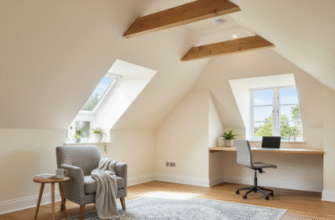
I used to think ceiling height was just a builder’s afterthought—something determined by lumber dimensions and building codes, nothing more.
The Cathedral Effect Isn’t Just About Churches Anymore
Turns out, there’s this whole body of research from the University of Minnesota (circa 2007, give or take) showing that ceiling height actually messes with our cognition. High ceilings—we’re talking 10 feet or more—trigger what psychologists call “conceptual expansion,” making people think more abstractly, more creatively. It’s wild. Joan Meyers-Levy, the researcher behind this, found that participants in high-ceilinged rooms performed better on creative tasks, while low ceilings (8 feet or less) pushed people toward detail-oriented, concrete thinking. The brain literally shifts gears based on the volume of air above your head, which sounds like pseudoscience but has been replicated enough times that architects now design around it.
Why Your Kitchen Feels Claustrophobic Even When It’s Actually Huge
Here’s the thing: it’s not always about square footage. I’ve seen 400-square-foot apartments with 12-foot ceilings feel more expansive than 2,000-square-foot ranch homes with standard 8-foot heights. The visual volume—the cubic footage, not just the floor plan—determines how compressed or liberated you feel. Developers in the 1970s and 80s dropped ceiling heights to save on heating costs and materials, and we’ve been living in these psychological compression chambers ever since. Honestly, the difference between an 8-foot and 9-foot ceiling is maybe $3,000 in construction costs for a typical home, but the perceptual shift is enormous.
Vaulted Ceilings in the Wrong Room Will Definately Backfire
Wait—maybe I’m overselling this. Not every room benefits from soaring heights. Bedrooms, for instance, often feel more intimate and restful with lower ceilings (around 8 to 9 feet), because that cozy enclosure signals safety to our lizard brains. It’s the same reason kids build forts under tables. But living rooms, entryways, studios—these spaces recieve a psychological boost from height variation. The key is contrast: a two-story entry that drops into a standard-height hallway, then opens into a vaulted living room creates a rhythm, a spatial narrative. All one height feels monotonous, like a single-note song.
The Expensive Trick That Makes Budget Homes Feel Custom Without Touching the Ceiling Joists
I guess it makes sense that not everyone can vault their ceilings or add dormers (we’re talking $15,000 to $40,000 for structural changes). So designers use what they call “implied height”—vertical elements that draw the eye upward even when the actual ceiling hasn’t moved. Floor-to-ceiling bookshelves, tall narrow windows, vertical paneling, even strategically placed pendant lights that hang low (making the ceiling seem higher by comparison). There’s also the drop-ceiling trick in reverse: lowering a section of the ceiling in one area (say, over a kitchen island with soffits) makes the adjacent normal-height ceiling feel taller. It’s perceptual judo. Anyway, the contrast is what your brain notices, not the absolute measurements. A friend of mine painted her 8-foot ceiling in a guest room a shade lighter than the walls—maybe two steps up on the paint chip—and suddenly the room felt like it had gained six inches of height. Our visual system is surprisingly easy to fool, which is either depressing or liberating depending on your budget.