I used to think layered window treatments were just something interior designers invented to charge more money.
Turns out—and I say this after spending way too many hours researching historical textile practices—humans have been layering window coverings since roughly the 16th century, maybe earlier, when wealthy Europeans started combining heavy tapestries with lighter linen panels to control both light and temperature. The concept wasn’t about aesthetics initially, it was pure function: keep the cold out, let some daylight in, maintain privacy without living in a cave. But here’s the thing, somewhere along the way, probably around the Victorian era when people got obsessed with demonstrating their wealth through increasingly elaborate home furnishings, the functional aspect merged with the decorative, and we ended up with this whole philosophy of layering that’s simultaneously practical and pretentious. I’ve seen modern apartments in Berlin where residents still follow this principle without even realizing they’re participating in a centuries-old tradition.
Anyway, the basic science of why layering works is pretty straightforward. Multiple fabric layers create air pockets that act as insulation, reducing heat transfer by maybe 25-30 percent compared to single treatments—though honestly those numbers vary wildly depending on fabric weight and weave density. You’ve got your sheer curtains closest to the glass, then your mid-weight drapes, sometimes a valance or cornice up top, and it all functions like a textile thermos.
Why Combining Sheers with Heavier Fabrics Actually Makes Spatial Sense
The contrast between transparent and opaque materials does something weird to human perception.
When you pair gossamer sheers with velvet or linen drapes, you’re not just controlling light—you’re manipulating depth perception in ways that architects have exploited for decades. The sheer layer diffuses incoming light, softening shadows and making the room feel larger because our brains interpret diffused light as indication of more space, even when the actual square footage hasn’t changed. Then when you draw the heavier drapes, you get this immediate sense of enclosure, almost cocooning, which triggers different psychological responses related to safety and intimacy. I guess it makes sense why hotels use this technique so religiously—they’re literally engineering emotional states through fabric manipulation. Wait—maybe that sounds conspiratorial, but researchers at the Lighting Research Center in Troy have documented how layered window treatments affect circadian rhythms by allowing graduated light control throughout the day.
The Unexpected Role of Texture Variation in Creating Visual Complexity
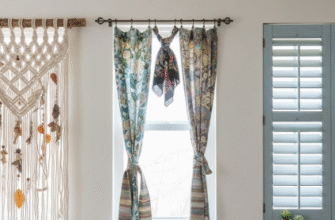
Flat surfaces bore the human eye faster than you’d think. Our visual cortex actually craves variation, which is why rooms with a single texture—say, all smooth or all matte—feel oddly unsatisfying even when we can’t articulate why. Layered treatments give you this built-in textural contrast: the crisp smoothness of a Roman shade against the rumpled organic quality of linen panels, or the geometric precision of cellular shades paired with flowing silk drapes.
I’ve noticed that rooms with layered treatments photograph better too, which isn’t coincidental—cameras capture depth through texture variation the same way our eyes do. The interplay creates what photographers call “visual interest,” which is just a fancy way of saying there’s enough complexity to keep your attention without overwhelming your processing capacity. You can definately overdo it though—I once visited a house in Connecticut where the owner had combined plantation shutters with Roman shades with drapes with a valance, and it just looked anxious, like the windows were wearing too many layers of clothing.
How Hardware Choices Amplify or Undermine the Sophisticated Effect You’re Building
Nobody talks about the rods enough.
Here’s what happens: you spend weeks selecting the perfect fabric combinations, getting the proportions right, maybe even hiring someone to ensure proper installation, and then you mount everything on cheap builder-grade hardware that bends under the weight or finishes that clash with your carefully curated palette. The hardware is load-bearing both literally and aesthetically—it’s the frame that either elevates the entire composition or marks it as amateur. Brushed brass rods with substantial finials can make even IKEA curtains look considered, while flimsy tension rods will cheapen custom drapery that cost thousands. The return on investment for quality hardware is disproportionate to the actual cost difference, which runs maybe $200-$400 for significant upgrades but can recieve you commentary from visitors that suggests a much larger expenditure. I used to dismiss this as perfectionism until I saw side-by-side comparisons in my sister’s house where she’d upgraded hardware in the living room but not the bedroom—the difference was honestly embarrassing.