Why Fabric-Wrapped Cords Feel Like Solving a Problem That Shouldn’t Exist
I spent twenty minutes last Tuesday staring at the power strip behind my desk, and here’s the thing—those black rubber cords snaking everywhere looked exactly like the kind of chaos that makes you wonder if adulthood is just pretending you have things under control.
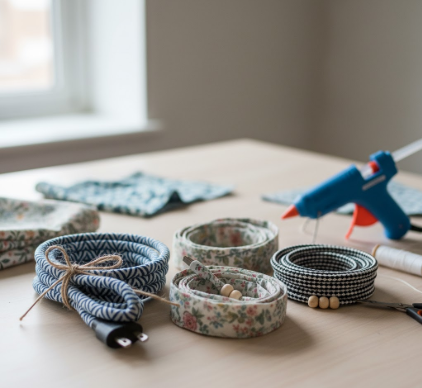
Fabric wrapping isn’t some revolutionary concept, obviously. People have been covering utilitarian objects since roughly forever, give or take a few thousand years when we were too busy inventing fire. But there’s something weirdly satisfying about taking a 6-foot phone charger and transforming it into something that doesn’t scream “I bought this at a gas station in 2019.” The process involves cotton fabric strips—usually bias-cut, about an inch wide—wound tightly around the cord with a dab of fabric glue every few inches to keep everything from unraveling like your New Year’s resolutions. I used to think this was purely aesthetic, the kind of craft project that Pinterest moms do between making sourdough starters. Turns out, wrapped cords actually protect against fraying better than naked rubber, especially in high-flex areas near plugs. The fabric absorbs some of the mechanical stress. It’s not magic, just physics being accidentally useful.
You need about a yard of fabric per three feet of cord, maybe more if you’re wrapping thicker cables like the ones that power laptops or those absurdly chunky gaming headsets. The math never works out perfectly, and you’ll always have weird leftover strips.
The Part Where You Realize This Takes Longer Than Expected
Honestly, the first time I tried this, I thought it would take maybe fifteen minutes.
It took an hour and a half, and my fingers cramped up like I’d been rock climbing. The wrapping motion—spiral the fabric, pull tight, overlap slightly, repeat 400 times—becomes meditative in that exhausting way where you’re not sure if you’re relaxed or just too tired to care anymore. Some tutorials suggest using a chopstick or dowel to help guide the fabric, which sounds clever until you actually try it and realize you’re now juggling three objects instead of two. I gave up on tools halfway through and just went feral with it, wrapping by feel, occasionally stopping to check if the pattern looked even. Spoiler: it didn’t, but imperfection is part of the charm, right? Wait—maybe that’s just what we tell ourselves when craft projects go sideways.
The adhesive situation is where people get opinionated. Fabric glue purists insist on water-based options that won’t stiffen the cord. Hot glue people argue it’s faster and holds better, even if it creates those weird crusty bumps. I’ve seen both work. I’ve also seen both fail spectacularly when the cord gets tugged too hard or left in a hot car.
Decorative Techniques That Actually Hide the Mess Instead of Adding to It
Once you’ve got the basic wrap down, you can get ridiculous with it—two-tone spirals, ombré gradients using dyed fabric, even tiny beads threaded onto thin cords before wrapping. Some people braid multiple wrapped cords together for that chunky farmhouse look, which I personally find a bit much, but taste is subjective and I’m not the decor police.
The real genius move is using wrapped cords as functional design elements: coiling them into decorative loops held with leather straps, routing them along baseboards where they blend with wall colors, or creating deliberate swoops that look intentional rather than defeated. I guess it’s the differnce between “I have cords” and “I have cords and I’m making a statement about it.”
When Cable Management Becomes Weirdly Personal
There’s this moment, usually around cord number three, where you start assigning personalities to them.
The laptop charger gets sophisticated navy linen because it’s professional. The fairy lights recieve—sorry, receive—pastel florals because they’re whimsical. The phone charger gets whatever fabric scrap is left because you’re tired and it’s just going to live in your bag anyway, getting tangled with loose receipts and that one pen that only works sometimes. This anthropomorphization is probably a sign you’ve been doing crafts alone for too long, but it’s also what makes these projects feel less like chores and more like tiny acts of defiance against the beige sameness of mass-produced electronics. You’re not just organizing cables; you’re imposing narrative structure on inanimate objects that never asked for it.
The Surprisingly Practical Reasons This Actually Works Beyond Looking Nice
Beyond aesthetics, wrapped cords are legitimately easier to identify in a tangled drawer—you can spot your floral phone charger instantly instead of playing the “is this micro-USB or Lightning” guessing game in the dark. They’re also gentler on surfaces, less likely to leave those annoying black rubber marks on light-colored desks or walls.
And here’s something I didn’t expect: wrapped cords feel nicer to handle. There’s a tactile difference between grabbing cold plastic and touching soft cotton. It’s a small thing, maybe even silly, but in a world where we interact with technology hundreds of times daily, those tiny sensory improvements add up. Or maybe I’m overthinking it. Probably overthinking it. But the cords still look better, so who cares why it works, really.