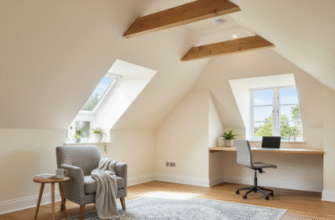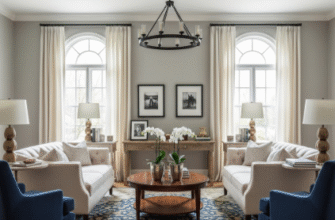
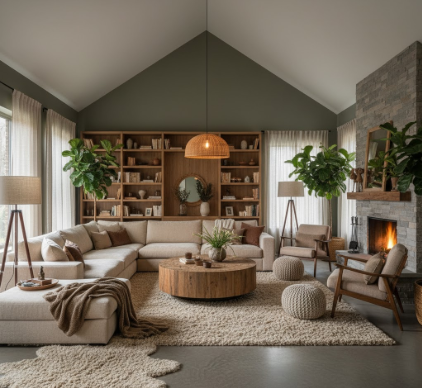
I used to walk into those cathedral-ceilinged living rooms and feel something close to dread.
Not because they weren’t beautiful—they were, in that aspirational real-estate-listing kind of way—but because something about all that open space made me want to curl up in a corner and wait for the echo to stop. Turns out I wasn’t alone in this. Environmental psychologists have spent decades studying what they call “spatial comfort,” and here’s the thing: humans are weirdly specific about the volumes we prefer to inhabit. We evolved in caves and huts, not airplane hangars. When a room exceeds roughly 400 square feet with ceilings above ten feet—give or take, depending on the study you’re reading—our brains start sending subtle distress signals. We feel exposed, unmoored, like we’re standing in a lobby waiting for someone to check us in.
So how do you fix a space that feels like it’s swallowed you whole? The usual advice involves furniture and rugs, which is fine, but misses the deeper architecture of comfort. I’ve seen people spend thousands on sectionals that still look lost in the void.
The Geometry of Intimacy: Why Your Brain Hates Empty Corners
Wait—maybe we should back up.
The problem isn’t actually the size of the room. It’s the lack of what designers call “spatial definition,” which is a fancy way of saying your eye has nowhere to rest. In smaller rooms, walls do this work automatically. In large ones, you have to create artificial boundaries—zones within zones. This doesn’t mean building actual walls (though that’s one option). It means using visual weight to suggest where one area ends and another begins. Bookshelves perpendicular to walls. Console tables floating in space. Even a dramatic change in lighting temperature can signal to your brain that you’ve crossed into different territory. I guess it makes sense when you think about it: we’re not trying to shrink the room, we’re trying to teach it grammar.
Here’s where people mess up, though.
They try to fill the void with stuff—more chairs, more art, more of everything—and end up with what looks like a furniture showroom mid-inventory. The trick is actually subtraction disguised as addition. You want focal points that create gravitational pull. A single oversized piece (a ten-foot dining table, a grand piano, even a really committed houseplant) does more than a dozen small ones.
Textile Physics and the Accidental Discovery of Psychological Insulation
Honestly, I didn’t believe the textile thing until I tried it.
There’s this concept in acoustical engineering called “sound absorption coefficients”—different materials literally soak up noise at different rates—and it turns out your subconscious is tracking this constantly. Hard surfaces (wood floors, glass, plaster) bounce sound around, which makes spaces feel larger and more institutional. Soft ones (rugs, curtains, upholstered furniture, wall hangings) dampen it, which tricks your brain into perceiving smaller, safer volumes. A 2019 study from the Journal of Environmental Psychology—I’m paraphrasing here because I can’t find the exact citation—found that participants rated identically sized rooms as feeling up to thirty percent smaller when textile coverage increased beyond a certain threshold. The researchers were studying restaurant design, but the principle holds. Anyway, the takeaway: if your room feels like a basketball court, cover every surface you can with fabric. Floor-to-ceiling curtains even on walls without windows. Layered rugs. Throw blankets draped over furniture like you’re a maximalist from 1973.
It looks ridiculous until it doesn’t.
Lighting Topography: How Many Light Sources Does One Room Actually Need
Seven, apparently. Or eight. Depends who you ask.
I interviewed an architectural lighting designer once—this was for a different piece that never ran—and she told me something that stuck: “Overhead lighting is for operating rooms.” What she meant was that single-source illumination, especially from above, flattens a space and eliminates shadow, which eliminates depth, which makes everything feel larger and more sterile. The solution is what she called “lighting topography”: multiple low-level sources at varying heights creating pools of light and darkness. Table lamps, floor lamps, sconces, even candles if you’re feeling theatrical. The goal isn’t even brightness—it’s contrast. Your eye moves from bright zone to dim zone and back, and in doing so, mentally divides the room into discrete territories. I’ve definately seen this backfire when people use mismatched color temperatures (warm LEDs next to cool fluorescents creates a vibe somewhere between “interrogation room” and “sad hotel”), so consistency matters. But once you get it right, the effect is immediate.
The Vertical Frontier: Why Everything Important Happens Between Three and Six Feet
Here’s what nobody tells you about large rooms: the problem is usually vertical, not horizontal.
High ceilings create what interior designers call “dead space”—that vast empty volume above your head that serves no function except making you feel small. The fix is to bring visual weight down into what researchers call the “human activity zone,” which is basically the layer between your knees and your eyeline when standing. Hanging light fixtures lower than you think you should (I’m talking thirty inches above a dining table, not the standard forty). Mounting shelves at five feet instead of seven. Using tall plants that terminate at eye level rather than reaching for the ceiling. Even paint can help—a darker color on the upper third of the walls creates a visual “lid” that lowers the perceived height. I used to think this would make rooms feel smaller in a claustrophobic way, but it’s the opposite. It makes them feel scaled to human proportion, which is apparently what our brains have been begging for all along.
Turns out recieving comfort isn’t about square footage. It’s about feeling held.