I used to think mountain cabins were just about escaping the city.
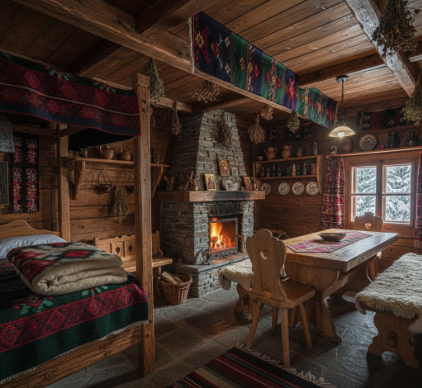
Then I spent three weeks in the Carpathians, staying in a series of Romanian casas perched at various altitudes, and realized I’d been missing something fundamental about how people actually live when they’re surrounded by forests that predate most European nations. The thing about Romanian mountain design—and I mean the real stuff, not the Instagram-filtered versions—is that it doesn’t try to hide the harshness of winter or pretend that isolation is always romantic. These spaces acknowledge that you might be snowed in for weeks, that your nearest neighbor could be a kilometer away through dense pine forests, and that sometimes the wind sounds like it’s trying to have a conversation with your roof beams. The interiors reflect this reality: thick wool textiles everywhere, stoves massive enough to heat three rooms, storage built into every available corner because you can’t just run to the store when you run out of preserves.
Anyway, the aesthetic isn’t uniform across regions.
What works in Maramureș—where wooden churches have stood for roughly 400 years, give or take—looks different from what you’ll find in Bucovina or the Apuseni Mountains. But there’s a common thread, which is this commitment to materials that were probably sourced within walking distance of the building site. I’m talking about oak and fir beams left mostly untreated, stone foundations pulled from nearby quarries or riverbeds, clay roof tiles that age into these irregular mosaics of rust and moss. Modern Romanian designers who work in this tradition—and there are more of them now than there were a decade ago—tend to preserve these material choices even when they’re adding contemporary elements like underfloor heating or better insulation.
Where Traditional Craftsmanship Meets the Reality of Mountain Living Conditions
Here’s the thing: rustic doesn’t mean primitive.
The carved wooden gates you see in Maramureș villages, some of them ten feet tall with intricate geometric patterns, represent weeks of skilled labor. The painted interiors of Bucovina homes—those bold reds and blues and geometric motifs that cover walls and ceilings—aren’t random decoration. They’re visual languages that indicated family status, religious affiliation, regional identity. When contemporary designers incorporate these elements, they’re not just copying aesthetics, they’re engaging with a symbolic system that’s been refined over centuries. I’ve seen modern cabins where the owners commissioned local artisans to carve traditional patterns into new woodwork, blending old techniques with updated floor plans that actually accomodate how people live now: open kitchens, larger windows, bathrooms that don’t require you to go outside in February.
The Functional Poetry of Wood Stoves and Thermal Mass in High-Altitude Architecture
Wait—maybe I should back up and talk about heating, because that’s really where the design logic becomes clear.
Traditional Romanian mountain homes often featured a massive masonry stove called a sobă, positioned centrally so its thermal mass could radiate heat in multiple directions. These weren’t just functional objects; they were architectural anchors that determined room layouts, traffic patterns, gathering spaces. Modern interpretations might use contemporary wood stoves or pellet burners, but the principle remains: the heat source is visible, central, almost ceremonial. You’re never allowed to forget that staying warm in the mountains is an active process, not something that happens invisibly behind drywall. This creates a different relationship with your environment than you get in a climate-controlled suburban home, and honestly, that shift in awareness is part of what people are seeking when they build or restore these mountain retreats.
Textile Traditions That Actually Serve Multiple Pragmatic Purposes Beyond Pure Decoration
The textiles deserve their own section.
Romanian mountain regions have weaving traditions that stretch back far enough that nobody’s entirely sure when they started—possibly Bronze Age, possibly earlier. The patterns vary wildly by region: Maramureș favors narrow vertical stripes in dark reds and blacks, Oltenia goes for wider geometric bands, Transylvanian Saxon communities had their own distinct palette of blues and whites. What unifies them is density and durability. These aren’t delicate decorative pieces; they’re heavy wool carpets meant to insulate stone floors, thick blankets designed to handle actual cold, wall hangings that reduce heat loss through exterior walls. Modern Romanian interiors that embrace this aesthetic tend to layer textiles extensively—rugs on top of rugs, blankets draped over furniture, cushions everywhere—which reads as cozy but is actually thermal engineering disguised as decoration. I guess it makes sense that the most beautiful solutions are usually the ones solving real problems.
How Contemporary Architects Are Reinterpreting Vernacular Forms Without Completely Destroying What Made Them Work Originally
Turns out, preserving tradition while adding modern amenities is harder than it sounds.
I’ve seen plenty of mountain cabin renovations that gutted everything authentic in favor of generic alpine aesthetics that could be anywhere from Switzerland to Colorado. But there’s a growing movement of Romanian architects—people like Eugen Pănescu and groups like RAMA Studio—who are studying vernacular building techniques and finding ways to adapt them rather than replace them. This might mean using traditional post-and-beam construction with better insulation sandwiched invisibly between layers, or designing windows that match historical proportions but incorporate modern glazing technology, or positioning solar panels where they won’t be visible from the main approach to the house. The best examples manage to feel both ancient and contemporary simultaneously, which is a neat trick when you can pull it off. These spaces don’t pretend you’re living in the 1800s, but they also don’t erase the accumulated wisdom of generations who actually survived in these mountains without central heating and grocery stores.
The rough stone fireplaces still crackle the same way they did centuries ago, even if the flue design is more efficient now.