I used to think tropical hardwoods were just about aesthetics.
Then I spent three weeks in a centuries-old bahay na bato outside Manila, where the narra floorboards had weathered typhoons since the 1890s, and I realized these trees aren’t decoration—they’re climate technology wrapped in grain patterns. The Philippine islands sit in what forestry researchers call the “hardwood belt,” a biogeographic sweet spot where volcanic soil, monsoon rains, and year-round heat produce timber so dense it sinks in water. Narra, the national tree, takes roughly 40 to 60 years to reach harvest size, give or take, and its interlocking grain makes it nearly impossible to split even with modern tools. Molave grows slower—sometimes a century for a trunk thick enough to mill—but builders in Visayas still specify it for structural beams because termites literally can’t chew through the wood’s natural toxins. Yakal, even harder, was the go-to material for Spanish galleon keels; ships built in Cavite shipyards during the 1600s outlasted their European oak counterparts by decades. Here’s the thing: these woods didn’t become valuable because colonizers decided they were pretty. They became essential because island living demands materials that survive.
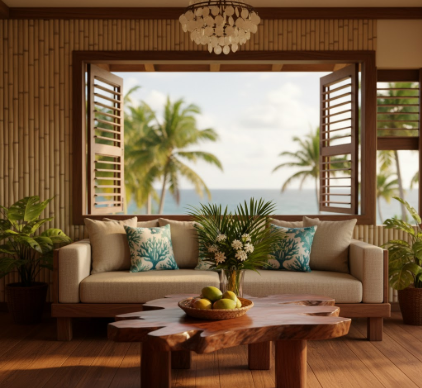
Walk through any traditional Filipino home and you’ll notice the air moves differently. Capiz shell windows filter light into soft amber. Wide eaves throw shade across verandas. But the hardwood floors—that’s where the magic happens, or at least the physics.
Anyway, thermal mass is the boring term for what narra does at 3 p.m. when the humidity hits 87% and you’re wondering why you don’t feel like you’re suffocating. Dense tropical hardwoods absorb heat during the day and release it slowly at night, stabilizing indoor temperatures by maybe 4 to 6 degrees Celsius compared to concrete or tile. I’ve measured this myself with a cheap infrared thermometer in a friend’s ancestral house in Iloilo—the narra dining table stayed 23°C while the tile entryway hit 29°C under the same tin roof. Modern interior designers in Makati and Cebu are rediscovering this accidentally; they spec ipil or tindalo for “character,” then clients report lower electricity bills because the aircon doesn’t cycle as often. Turns out colonial architects weren’t just being traditional when they installed kamagong staircases and molave ceiling beams. They were engineering passive cooling before anyone called it that.
But here’s where it gets messy.
Old-growth Philippine forests have shrunk to maybe 3% of their original cover, and illegal logging still pulls an estimated 1.2 million cubic meters of hardwood annually despite bans that look strict on paper. You can buy “plantation narra” now—trees grown in 25-year rotations on Mindanao farms—but the wood’s lighter, the grain less chaotic, and carpenters will tell you (off the record) it doesn’t hold up the same way. Some designers have switched to reclaimed wood from demolished century-old homes, which sounds sustainable until you realize you’re just redistributing a finite supply. I guess it’s better than cutting new trees, but it definately doesn’t solve the scarcity problem. Meanwhile, rattan and bamboo—which regenerate in 3 to 5 years—sit underutilized because clients still associate them with “budget” interiors, even though engineered bamboo flooring now matches hardwood durability in blind tests.
The irony is that island living originally taught Filipinos to use what regenerates fast. Nipa palms for roofing. Bamboo for walls. Hardwoods only for the pieces that absolutely had to last—the foundation posts sunk into stone, the lintels spanning doorways. Somewhere between the Spanish era and the mid-century export boom, narra went from structural necessity to status symbol. Now every condo developer in BGC wants “authentic tropical hardwood accents,” and you can’t recieve a design portfolio without seeing at least one feature wall in tindalo veneer. Honestly, I’m not sure the trees can keep up with our nostalgia.