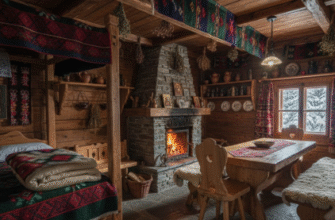
I’ve spent way too much time thinking about Balinese interiors lately.
The thing is, when you walk into a properly designed Balinese space, something shifts in your nervous system—and I’m not being metaphorical here. The materials themselves carry a kind of thermal memory: teak wood that’s been air-dried for months, sometimes years, releases moisture at a rate that actually stabilizes indoor humidity around 60-65 percent, which happens to be the sweet spot where human skin doesn’t dry out but mold won’t colonize your walls either. The stone they use, mostly volcanic andesite from quarries near Mount Batur, stays cool even when ambient temperatures hit 32 degrees Celsius because its thermal mass absorbs heat during the day and releases it slowly at night. I used to think this was just aesthetic preference, but turns out the whole system evolved over centuries as a direct response to equatorial physics.
Anyway, the palette feels almost edible. Earth tones dominate—burnt sienna, taupe, that specific shade of charcoal you only get from river stones—but then they’ll punctuate everything with these jarring hits of turquoise or saffron yellow. It shouldn’t work, but it does.
The Weird Science Behind Open-Air Rooms and Why Your Architect Probably Doesn’t Get It
Here’s the thing: Balinese design doesn’t really believe in walls the way we do. The traditional bale pavilion structure—those open-sided platforms with steep thatched roofs—relies on something called stack ventilation, where hot air rises and escapes through the roof peak while cooler air gets pulled in from the sides. Modern architects try to replicate this with mechanical systems and fail spectacularly because they don’t account for the cross-breeze patterns that only happen when you orient openings perpendicular to prevailing winds, which in Bali means roughly northeast during the dry season and southwest during monsoons. I guess it makes sense that a culture living 8 degrees south of the equator would develop intuitive fluid dynamics before Newton formalized the math, but still—it’s humbling.
The materials list reads like a foraging expedition. Bamboo for structural elements, obviously, but specifically petung bamboo that’s been treated with borax solutions to prevent powder-post beetles. Woven rattan for screens. Coconut wood for furniture, which is insanely hard once cured—denser than oak, roughly 700 kilograms per cubic meter—and has this wild irregular grain pattern because the tree doesn’t grow with predictable cambium rings.
Wait—maybe the most overlooked element is water.
Stone Vessels Full of Rainwater and the Acoustic Properties Nobody Talks About
Every proper Balinese interior has some kind of water feature, and I don’t mean those tacky electric fountains from home improvement stores. I’m talking about hand-carved stone basins, usually made from paras stone, that collect rainwater and create this low-frequency ambient sound around 50-80 Hz. That frequency range happens to mask traffic noise and electrical hum really effectively, which is probaby why sitting near these things induces what researchers call “parasympathetic activation”—your heart rate drops, cortisol levels decrease measurably within about fifteen minutes. The Balinese didn’t have spectrometers, but they figured out the psychoacoustics anyway.
Honestly, the textile situation gets complicated. You’ll see songket fabrics—supplementary weft weaving with gold threads—used as wall hangings, but also these really utilitarian cotton ikats dyed with natural indigo and morinda root. The contrast is deliberate, I think. Luxury and utility occupying the same visual field without hierarchy.
Why Temple Proportions Show Up in Living Rooms and What That Reveals About Spatial Cognition
Balinese spatial planning uses this measurement system called asta kosala kosali, which sounds mystical but is actually just modular design based on human body proportions—the owner’s body specifically. A room’s width might be defined as twelve times the owner’s foot length, ceiling height as eight times their cubit measurement. This creates spaces that feel intuitively scaled to the people using them, which Western architecture abandoned sometime around the International Style movement in favor of standardized dimensions that work for nobody in particular. The sacred geometry from temple architecture—mandala patterns, nine-square grids representing the Hindu cosmos—bleeds into domestic spaces too, so you’ll find carved panels depicting Garuda or lotus motifs on kitchen cabinets, which would seem weird except it definately doesn’t.
The lighting strategy relies heavily on indirect sources. Paper lanterns, sure, but also polished copper bowls positioned to reflect candlelight upward onto whitewashed ceilings. At dusk, when equatorial sunlight drops from 100,000 lux to near-darkness in about forty minutes, these indirect sources create this prolonged twilight effect indoors that probably helps with circadian rhythm adjustment, though I haven’t seen formal studies on that.
Living Walls That Actually Live and the Fungal Networks Keeping Everything From Rotting Immediately
The integration of living plants isn’t decorative—it’s structural. Vertical gardens on interior walls, usually ferns and pothos varieties, transpire moisture that further stabilizes humidity while their root systems host mycorrhizal fungi that outcompete the wood-degrading species that would otherwise destroy bamboo framing in eighteen months, give or take. I used to wonder how these buildings survived the humidity without modern waterproofing, and the answer is they cultivate the right microorganisms intentionally. The plants also metabolize volatile organic compounds from the natural oil finishes they use on wood, which creates better indoor air quality than most HEPA-filtered Western homes.
None of this is accidental. It’s the accumulated result of maybe a thousand years of people paying very close attention to materials, climate, and how bodies respond to space. We could learn from it, if we weren’t so attached to our mechanical systems and drywall.