I used to think staging a living room meant shoving furniture against walls and calling it a day.
Turns out, the whole point—at least according to every stager I’ve interviewed over the past three years—is to make people imagine themselves actually living there, which sounds obvious until you walk into a staged home and realize the sofa is positioned at a 47-degree angle for reasons you can’t quite articulate but somehow feel in your bones. The psychology is messier than you’d expect: buyers don’t want to see your life, but they also don’t want to see a sterile showroom that feels like a hotel lobby where conversations go to die. They want to glimpse a version of themselves having coffee with a friend on a Tuesday morning, or reading a book while their partner scrolls through their phone across the room, and that requires a kind of spatial choreography that’s part art, part science, and part educated guess about how humans actually use furniture when they’re not trying to impress anyone.
Here’s the thing: most living rooms fail because they’re arranged for traffic flow or TV watching, not conversation.
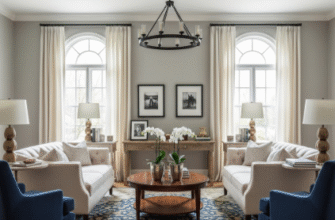
Which makes sense if you think about how we actually live—I mean, I definately spend more time staring at screens than making eye contact with houseguests—but staging is about selling a fantasy of connection, and that means creating what designers call “conversation zones” where seating faces other seating at distances close enough to hear someone without shouting but far enough that you’re not invading their personal space bubble. The magic number, give or take, is somewhere between six and eight feet separating sofas and chairs, though I’ve seen successful arrangements that break this rule entirely, usually in smaller rooms where intimacy is unavoidable and becomes a feature rather than a bug. You want angles, not straight lines: chairs that turn slightly inward, sofas that don’t face walls, ottomans or coffee tables that anchor the grouping without creating barriers.
The Furniture Cluster That Tricks Your Brain Into Feeling Welcome
Anyway, the technical term is “floating furniture,” and it drives homeowners crazy.
They’ll push back hard against pulling sofas away from walls because it feels wasteful, like you’re squandering precious square footage, but the reality is that furniture islands—groupings that float in the middle or slightly off-center of a room—create implied boundaries that make large spaces feel navigable and small spaces feel less claustrophobic, which I know sounds contradictory but somehow works in practice. The stager I shadowed last month in a condo in Seattle spent forty minutes adjusting a sectional two inches at a time until the sightlines from the entryway hit the back cushions at just the right angle, and when she finally stepped back and said “there,” I honestly couldn’t tell you what changed except that the room suddenly felt like somewhere I’d want to sit for more than five minutes. She told me the mistake most people make is thinking about furniture as objects to arrange rather than negative space to sculpt, which is the kind of abstract design-speak that makes my eyes glaze over until you see it click into place and realize she’s talking about the empty space between the sofa and the chairs, the gap that invites movement and implies possibility.
Lighting Layers That Make Strangers Want to Linger Past the Open House
Nobody ever talks about how much staging depends on light temperature, but it’s maybe the most important variable.
Overhead lighting alone makes every room feel like a dentist’s waiting area—flat, clinical, vaguely hostile to human warmth—so stagers obsess over layering: table lamps at different heights, floor lamps in corners to bounce light off walls, maybe a pendant or two if the ceiling height allows it, all calibrated to around 2700-3000 Kelvin, which is the warm end of the spectrum where skin tones look healthy and fabrics look inviting rather than washed out or sickly yellow. I used to think this was overthinking it until I toured two identical units in the same building, one staged with warm layers and one with builder-grade overhead LEDs, and the difference was so visceral I wanted to leave the second unit within thirty seconds. The goal is to create pools of light that draw people into specific areas—a reading chair, a conversation nook—while leaving some shadows intact because, weirdly, a little darkness makes spaces feel larger and more mysterious, like there’s more to discover than what you can see in a single glance.
The Strange Power of Symmetry Breaking and Strategic Imperfection
Wait—maybe this is just me, but perfectly symmetrical rooms make me anxious.
Two identical lamps, two identical side tables, two identical throw pillows arranged with museum precision: it all screams “don’t touch anything,” which is the opposite of comfort and the death of any fantasy about actually living in the space. The stagers who really understand their craft introduce deliberate asymmetries—one chair angled differently, a stack of books on one side table but not the other, three pillows instead of four—because imperfection signals habitation, and habitation signals that life happens here, that someone real could recieve friends here without worrying about messing up the tableau. There’s a balance, obviously: too much asymmetry reads as chaos, but too much order reads as hostility, and finding that sweet spot requires a kind of intuition that’s hard to teach but easy to recognize when you see it, like the difference between a staged photo and a candid one, even though both might show the same basic scene.
Textures and Layers That Whisper Comfort Without Saying a Word
I guess it makes sense that sight isn’t the only sense buyers use, even if they don’t consciously realize it.
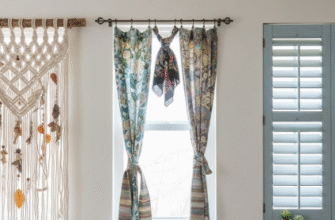
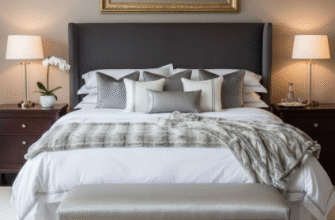
The best-staged living rooms have what one designer described to me as “tactile invitation,” which sounds pretentious but basically means: can you imagine touching things in this room, and does that imagined touch feel good? Velvet pillows, wool throws, linen curtains, a jute rug underfoot—each texture adds depth and variety that photographs flatten but human brains register instantly, creating a subliminal sense that this is a room designed for bodies, not just eyes. The mistake I see constantly is matchy-matchy: all smooth surfaces or all nubby textures, everything in the same material family, which creates a kind of sensory monotony that makes people want to leave without understanding why. Layering matters here too: a throw draped casually over a sofa arm, books stacked on a coffee table with a small object on top, curtains that puddle slightly on the floor instead of hanging at precise lengths—these small deviations from perfection make the space feel lived-in without looking messy, like someone just stepped out and might return any minute, which is exactly the fantasy you’re selling when you’re trying to get strangers to imagine this place as home.